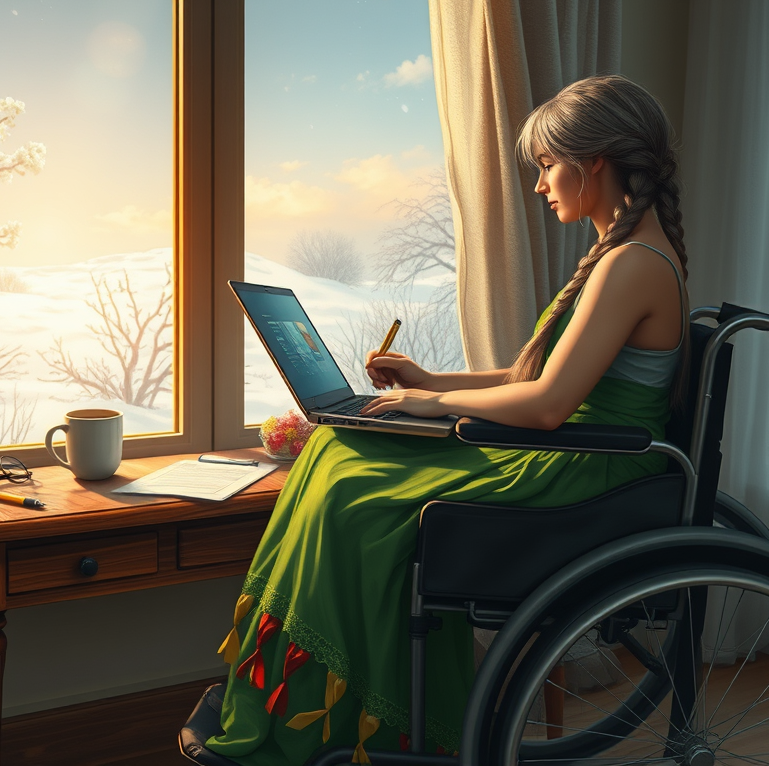

It’s been on my mind lately—this idea of how different parts of ourselves interact and shape the way we move through the world.
I’ve known about my ADHD for as long as I can remember—it’s been part of who I am since childhood. But learning about Autism was a much more recent discovery, just a few years ago. It was like finding out I’ve been playing life on hard mode without realizing it, and suddenly someone handed me a cheat sheet. Not knowing about the ASD side of me for so long made balancing these two aspects even harder, because I was trying to understand myself without a pretty important piece of who I am.
Living with both Autism and ADHD can feel like managing two personalities that don’t always get along. One thrives on structure, the other on chaos. It’s like having one foot tapping to a waltz and the other doing the macarena—neither one is wrong, but it does make dancing through life… interesting. Recently, I started listening to a podcast called AuDHD on Spotify, and every episode so far has felt like they’re reading my journal entries. It’s been such a relief to finally understand the ways these two diagnoses interact—how they can conflict and how they shape everything from my creative process to building friendships.
What has really helped me on this journey is the lesson of self-acceptance I’ve learned through my Cree heritage. In our teachings, there’s a deep understanding that everyone walks their own path, and those steps need to be taken with a pair of moccasins (makasinak, ᒪᑲᓯᓇᐠ) that are made just for them—not just for anyone with the right shoe size. And let me tell you, these fresh moccasins of mine are finally starting to fit in all the right ways, even if they’re a bit stiff at first.
As a writer, I see this interplay show up in my characters and the stories I create. It’s also something I’m learning to navigate in real life, like figuring out how to connect with people and get the word out about my blog. In a way, it feels like I’m relearning how to make friends from the ground up—a challenge, sure, but also an opportunity to grow and embrace this journey with a fresh pair of moccasins (makasinak, ᒪᑲᓯᓇᐠ) that truly fit.”
Understanding the Overlap
Autism and ADHD each bring their own set of traits to the table, and when they come together, it’s like having two different maps for navigating the same world. Autism often brings a focus on structure, patterns, and sensory sensitivity, while ADHD thrives on spontaneity, impulsivity, and a little dash of chaos. Neither map is better or worse—they’re just different, and the challenge comes in trying to use both at the same time, especially when it comes to making connections with people.
For much of my life, I didn’t know that Autism was part of who I am, and that made it harder to navigate social situations. Without that understanding, I struggled to find ways to mitigate the overwhelm and discomfort that came with being around others. It wasn’t that I didn’t want to connect—I’ve always craved meaningful relationships (wîcêhtowin, ᐄᒉᐦᑐᐏᐣ) and the energy of shared moments. But the sensory overload, missed social cues, and conflicting needs of Autism and ADHD made me retreat instead. I became more of a hermit, not because I wanted to hide away, but because every attempt to reach out felt like shouting into the void, unheard and unseen. The loneliness this created was heartbreaking, but it also fueled a fire in me to find a way forward, to understand myself and the connections I so deeply desire.
This longing and struggle have found their way into my writing in profound ways. My characters, with their vulnerability (nîkânîwin, ᓂᑳᓂᐏᐣ) and knack for stumbling into trouble, carry pieces of me—the conflict between Autism and ADHD, the raw emotions of feeling misunderstood, and the resilience to keep trying. Writing isn’t just a creative outlet for me; it’s my lifeline, a way to process, explore, and sometimes even heal. Each story I craft reflects not only my challenges but also my passion for understanding the world and myself.
The Unique Positives
What’s more, I’ve realized that the creativity from my ADHD and the eye for detail from my Autism aren’t just traits—they’re gifts. They bring my characters to life with a realism and depth I wouldn’t have otherwise. These lifelong challenges with friendships have given me the perspective to write relationships (wîcêhtowin, ᐄᒉᐦᑐᐏᐣ) that feel authentic, messy, and deeply human. While the road has been anything but easy, it’s led me to a place where I can pour my heart into my writing—a space where I can reflect, grow, and connect in ways that are both personal and universal.”
Living with both Autism and ADHD is like being handed two instruction manuals in two completely different languages—and neither one has a translation guide. For most of my life, I’ve been trying to piece things together, convinced I was using the wrong manual altogether. Spoiler alert: I wasn’t broken or doing things wrong. I just didn’t know how to read the fine print yet.
But here’s the wild part: once I started figuring out the mix of chaos and focus that comes with these two, I realized there are some pretty amazing strengths in the combo. ADHD fills my mind with more ideas than I know what to do with (seriously, I could probably power a small city with them), while Autism helps me bring those ideas down to earth, turning them into something real. It’s like having a brainstorming machine and a precision tool in one. Whether it’s putting words on a page or finding little ways to connect with people, these gifts are becoming my secret weapons.
Friendships, though? Oh boy. That’s been a tougher nut to crack. Autism lets me notice the little things about people—the way they smile when they’re nervous, the way they take their coffee, or that one time they mentioned their favorite childhood movie. But then, bam! ADHD shows up and I’m blurting out something random that makes no sense in the moment. And don’t even get me started on missing social cues. Turns out, not realizing someone wants to wrap up a conversation or that you’ve been oversharing is a bit of a roadblock when trying to make friends. It’s no wonder I’ve spent a lot of time feeling like a lonely outsider, stuck between wanting to connect and not knowing how to make it happen.
And then there’s the embarrassment—the years spent feeling like I didn’t fit, like there was something fundamentally wrong with me. Growing up, I thought I was broken. Society sure didn’t do much to convince me otherwise, with its endless emphasis on fitting molds and playing by rules that seemed like they were written in invisible ink. But things started to shift when I reconnected with my biological father (nohtâwiy, ᓄᐦᑖᐏᕀ, which means “my father” in Cree) and my family from the rez. Meeting my siblings, finding my place in the larger web of kinship, and discovering the cultural richness I’m part of changed everything.
You know how people in First Nations communities call each other “cousin”? It’s not about traditional family trees—it’s about the ties that connect us all. We’re family through Mother Earth and the heartbeat that resonates within us. This sense of wâhkôhtowin (ᐋᐦᑯᐦᑐᐏᐣ, the Cree word for kinship and interconnectedness) helped me see myself differently. It showed me that I wasn’t broken; I was part of something bigger, something beautiful.
Poetry has always been there for me, patiently waiting, but even that has transformed with this acceptance. Writing used to be a whisper in the background of my life. Now it’s more like a full-blown jam session. It’s where I say, ‘I’m not broken. I’m me.’ It’s where I pour all the messy, complicated, wonderful parts of myself, and somehow, it turns into something that feels like home.
So, yeah—Autism and ADHD have made life interesting, to say the least. It’s been equal parts chaos and clarity, confusion and discovery. But I’m finally starting to see the unique positives in it all. As I lean into these strengths, I’m hopeful they’ll help me write characters that feel real and relationships (wîcêhtowin, ᐄᒉᐦᑐᐏᐣ, meaning “the act of helping or being with others”) that feel solid. Who knows? Maybe this chapter of self-acceptance will turn out to be the best one yet.”
Living with both Autism and ADHD sometimes feels like being trapped in a world that wasn’t built for you. And when that world is layered with cruelty, judgment, and abuse, it leaves behind not just scars, but wounds—wounds that are still open, some that have festered from being left untreated for so long. For as long as I can remember, I’ve been made to feel like I was broken—too different, too much, and at the same time, not enough. From childhood, I’ve faced abuse in many forms—sometimes because my differences weren’t understood, and other times simply because I didn’t fit society’s idea of “normal.” Those experiences left deep marks on me, shaping how I saw myself and how I navigated the world.
Abuse doesn’t just leave physical or emotional wounds—it takes something much deeper. For me, it stripped away my self-esteem, self-value, and self-respect. It left me with little to no confidence, convincing me that I was inherently flawed. When the people you trust most—parents, family, teachers—reinforce the idea that you’re broken, that you need to be fixed or molded to fit into what is “expected,” it warps how you see yourself. Society echoed that message with its relentless standards of “normalcy,” and for years, I believed what I was told. Learning coping skills in such an environment became almost impossible because I couldn’t separate my worth from the belief that I was a failure.
School added another layer to the pain. Children can be cruel, especially to those they don’t understand. Ridiculed by classmates for being different, I learned to fear standing out, to shrink myself so I wouldn’t become a target. The classroom—meant to be a space of growth and discovery—often became a minefield, where every misstep or misunderstood action drew judgment or laughter. Those memories still linger, heavy with the sadness of being constantly reminded that I didn’t belong.
And often, I wonder—did the way I was treated create my depression? Did the abuse from those I trusted, classmates, and society itself carve out this heavy shadow that follows me even now? Some days, I wonder if I would even have depression if people like me, who are too different, were simply accepted. We have gifts—some truly great gifts—that too often go unharnessed because of the way we are treated. It’s heartbreaking to think of the potential lost, not just for individuals like me but for the world that rejects what we have to offer.
I’m lucky in one respect—I am stubborn. That stubbornness has kept me from fully giving in to the weight of it all. I am willing to constantly fight, even when it feels like an uphill battle. But that resilience doesn’t erase the impact of what I’ve endured. It doesn’t minimize the ways abuse, judgment, and rejection have shaped me and still affect me to this day. It has taken so much for me to start learning who I am, to develop the coping skills that help me navigate life more effectively. These interactions may happen less often now as I learn and grow, but the question remains—why should I have to change for society? Why can’t I just be accepted as I am, and why can’t the gifts I offer be nourished instead of ignored or diminished?
The fear of speaking, of saying the wrong thing, of being met with ridicule or anger, still lingers in the corners of my mind. The sadness of that reality is a weight I carry, one that makes it hard to stand tall some days. Many of the wounds from my past remain open, and some have festered from being left untreated for so long. It is only recently that I’ve begun to learn who I truly am, and in doing so, I’m discovering the skills I need to function better and, ultimately, to heal. That process—of learning, understanding, and accepting myself—is an essential part of turning these open wounds into scars. Yet, even scars carry their own vulnerability. They can be reopened so easily, with just a word or a glance, leaving me feeling shattered and raw all over again. Society hasn’t made it easier—it treats differences like flaws, something to fix or hide rather than understand and embrace. That message sinks in deep, shaping how you see yourself, convincing you that you’ll never be enough. And even now, as I work to overcome those thoughts, I feel the sting of all the times I was made to feel small, to feel invisible.
Sensory overload only adds to the weight of it all. The noise, the lights, the textures that don’t feel right—it’s like the world itself is screaming at me to retreat. When you have both Autism and ADHD, the experience of sensory overload takes on an even more intricate and exhausting dynamic. For my Autism, sensory input can feel overwhelming because my brain processes it in such vivid detail and so many things at once. Like a computer, the autistic brain processes a lot, so when overload hits, all of that information crashes in—even if we don’t recognize it on a conscious level. Without Peace, I would not be able to be independent and live on my own. These overloads can impact basic needs to such a great degree. While I am far more than capable of handling my own needs, I just need a living medical device that can differentiate between what I need based on their training and their own senses—which are often more superior than ours.
At the same time, my ADHD amplifies the chaos, making it harder to focus or calm my mind when everything feels too loud, too bright, and simply too much. ADHD often brings a heightened sensitivity to distractions, and in a sensory overload state, it’s like the distractions are on steroids. Each stimulus competes for attention, pulling my focus in a dozen different directions until I feel like my brain is a tangled knot of frayed wires, sparking and short-circuiting all at once.
Even when I try to seek refuge, the coping mechanisms for one condition can clash with the other. My Autism craves predictability and control over my sensory environment—quiet spaces, dim lights, and soft textures. However, my ADHD pushes back against prolonged stillness, making it difficult to fully rest or recharge. It’s a constant push and pull, leaving me stuck in an exhausting cycle where neither condition is willing to relent.
The struggle is even more pronounced in everyday activities, which can turn into insurmountable challenges. For instance, a trip to the grocery store becomes a gauntlet of noise, colors, and movement. The bright overhead lights, the cacophony of beeping registers, the overlapping murmur of conversations, and the ever-changing music all hit me at once. My Autism catches every sound and detail, while my ADHD struggles to focus on the task at hand, leaving me frozen, unable to decide whether I need apples or oranges. Adding to this are the tactile experiences—the feel of grocery cart handles, the clothing against my skin, and the cold blast of air from the freezer aisle—all bombarding me simultaneously. It’s not just overwhelming; it’s suffocating.
When it becomes too much, and I find myself unable to cope, Peace, my service dog, steps in. This is often a moment where I sit in the middle of a grocery store aisle, trying to ground myself. To a passerby, it might look like I’m simply sitting there petting my dog. But the reality is far more profound. Peace lies against me or places her weight on my legs, applying steady, grounding pressure that helps anchor me in the moment. This pressure is calming and regulating—it interrupts the spiral of sensory overload and brings me back to a place where I can function.
This scene might be familiar to some, especially if they’ve seen portrayals of PTSD in television or social media, where a service dog provides pressure therapy to help calm and ground someone during a triggering moment. It’s important to understand, however, that this task serves a wide range of people, including those like me whose battles are just as invisible, just as real, and just as debilitating. For someone with Autism, ADHD, or overlapping conditions, pressure therapy is not just a comforting gesture—it’s a medical necessity. It’s the difference between being overwhelmed to the point of shutting down and being able to complete everyday tasks, like buying groceries.
This overload doesn’t just impact the body—it tears at the mind and spirit. The grief of these experiences lingers, steeped in the memories of being dismissed or misunderstood by others. Comments like “Why can’t you just ignore it?” or “You’re overreacting” cut deep because they overlook the profound and very real challenges of managing the input my brain can’t tune out. The shame of not being able to cope “normally” is yet another weight I carry, making it even harder to face the world.
Noise-canceling headphones help quiet the external chaos, offering me a temporary cocoon of calm. Dim lighting soothes the overstimulation of my senses, and soft clothing helps me feel grounded in a world that often feels abrasive. Yet, these tools aren’t a cure-all. They don’t erase the grief of all the times I’ve been overwhelmed and had no escape, no understanding. Nor do they take away the loneliness of being invisible in my struggle.
Even so, in the midst of this sensory battle, there’s a bittersweet beauty in the sensitivity itself. My heightened awareness allows me to notice the smallest, most delicate details—the way sunlight dances on water, the gentle rhythm of Peace’s breathing when she lies by my side. In those moments, I find a quiet kind of magic that keeps me grounded. It’s not enough to erase the challenges of sensory overload, but it reminds me that this sensitivity, while exhausting, is also part of what makes me who I am.
The grief and despair that come with these wounds are not something that fades easily—if they fade at all. I’m not even sure they do. Instead, you grow stronger, with the right elements in your life helping you learn to carry them. For me, one of those elements has been the acceptance I’ve found among the Cree people and other Indigenous individuals from different nations. They’ve given me something immeasurable—a place to begin healing, to learn who I am, and to start walking a path toward self-acceptance. It’s like they offered me new moccasins that fit me, ones that allow me to take the first steps on this journey.
Another source of strength has been this blog. Every person who reads my posts, who likes what I write, who follows along, or who becomes a repeat visitor gives me a boost in confidence and self-esteem that I thought was beyond repair. Years of destruction—caused by society, by my own family, and by those I’ve trusted—left me feeling like there was nothing left. But you, my readers, have given me the small but significant sparks that reignite my sense of worth. Every kind gesture, every like, every follow—it’s a step forward, a small piece of momentum that helps me keep going.
There are so many others who feel as I do and who have faced even worse, and knowing that breaks my heart in ways I can barely put into words. Especially when I think of those who haven’t yet found their voice or are too scared to speak out because of what the world has done to them. I don’t just write for myself; part of what gives me the strength and ability to share so openly is knowing that these individuals are out there. Perhaps they read this and feel less alone. Even better, maybe they’ll find their own voice—even if it’s just to share their story here anonymously.
I want to help others, and if sharing my pain and my journey does that, then going through all of this so publicly becomes even more meaningful. No matter what, I know I am a healer at heart. It’s not just a role—it’s my calling, as much as writing is. And for those who follow me, your reach probably extends far beyond me. You may not realize it, but by being here, by reading and engaging, you may be helping someone feel less alone. Someone who is struggling in ways that are hard to comprehend, in ways that can lead to the darkest places. For all you know, you might even be saving a life.
The butterfly effect is strong. While this process—writing about my pain—is far beyond painful, filled with countless Kleenex and moments where my service dog steps in to help me through, I know it’s worth it. It’s worth it because I don’t feel so alone, and because even if I never hear of it, I trust that this helps others feel less alone too. I’ve seen firsthand how even the most tragic journeys can give hope to someone else who thought they had none. To the Indigenous people, to the very few individuals—like three in the USA and one in Australia—who have stood by me, and to everyone who reads these posts: my thanks comes from the depths of my heart. Even in the Cree language, as rich and descriptive as it is, I don’t think there are words powerful enough to express my gratitude for what you’ve done for me. You’ve not only helped me take small but vital steps forward—you’ve given me hope. Hope in a world that can often be so cruel to those who are different. Your impact on me is profound, and your kindness and support heal in ways I could never have imagined. You help me keep my strength every single day, and though I may not know your names, I will never, ever forget the help you’ve given me.”
Closing Thoughts
Living with both Autism and ADHD has been quite the journey for me. I’ve known about my ADHD since childhood, but discovering my Autism more recently felt like getting a cheat sheet for life. It’s like managing two personalities—one loves structure, and the other thrives on chaos.
My Cree heritage has taught me self-acceptance, emphasizing that everyone walks their own path with moccasins made just for them. This journey has influenced my writing and social interactions, making it both challenging and rewarding to connect with others.
The combination of ADHD’s creativity and Autism’s attention to detail gives me unique strengths, helping me create realistic characters and authentic relationships. My service dog, Peace, provides grounding pressure therapy during sensory overload, which is crucial for managing everyday tasks.
Acceptance from the Cree community and support from blog readers have been instrumental in my journey towards self-acceptance and healing.
If you enjoyed reading about my experiences, please consider subscribing to my blog for more updates. Your support means the world to me and helps me continue sharing my journey. Feel free to leave a comment or share your own story—let’s connect and support each other! 😊 And don’t forget to share this blog with your friends and family who might find it helpful or inspiring!
 Who am I?
I would love to hear from you!