
Opening Reflection: Living with Mobility Challenges
Mobility challenges shape every aspect of life, often in ways that others may not even realize. For me, these challenges have become part of my daily rhythm, influencing how I interact with the world and approach even the simplest tasks. They’ve taught me mîno-pimohtêwin (the good way of walking, ᒦᓄ ᐱᒧᐦᑌᐏᐣ), a sense of resilience, and have opened my eyes to the maskihkîwi-sakahikan (obstacles, ᒪᐢᑭᐦᑮᐏ ᓴᑲᐦᐃᑲᐣ) that still exist in society.
I’ll admit, my environment isn’t exactly what you’d call mobility-friendly. Most of my writing is done from my bed—not because I’m lazy (though I do appreciate a good nipâwin (rest, ᓂᐹᐏᐣ) after a long day) but because I’ve had to adapt to a home that doesn’t accommodate my needs. Let’s be honest, I’m far too asinahikam (stubborn, ᐊᓯᓈᐦᐃᑲᒻ) for my own good. I often ignore my limits entirely, pretending they don’t exist, only to pay for it later when my body says, “You had your fun; now it’s my turn.”
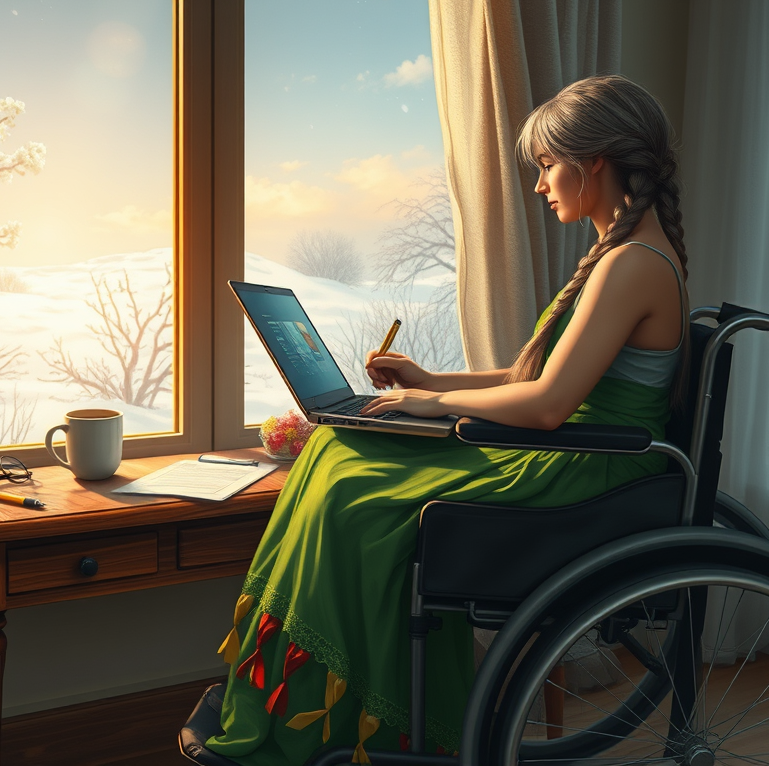
The real impact of these challenges, though, shows up in surprising places—like my ability to write. Some days, sitting up to string together words feels like climbing a mountain. On other days, inspiration flows so easily it’s like my pimohtêwin (journey, ᐱᒧᐦᑌᐏᐣ) is carried on the winds. If nothing else, my stubborn streak ensures I show up for the page—even if showing up looks like balancing a laptop precariously while buried under blankets.
Navigating these challenges goes beyond the physical—it’s a journey of emotional strength and adaptability. Each step is a reminder of the balance between determination and the limitations imposed by both my body and the environment around me. These experiences have become part of who I am, shaping not only my day-to-day life but also my perspective and voice as a writer.
Societal Impact: Barriers Seen and Unseen
Living with mobility challenges is difficult enough, though society often adds an extra layer of maskihkîwi-sakahikan (obstacles, ᒪᐢᑭᐦᑮᐏ ᓴᑲᐦᐃᑲᐣ) that can feel insurmountable. Public spaces, for example, frequently lack accessibility features that many of us rely on—ramps, elevators, even doorways wide enough for wheelchairs. When society overlooks these essentials, it sends a message that kayâs-pimohtêwin (the old way of walking, ᑲᔭᐢ ᐱᒧᐦᑌᐏᐣ) is still the default, and those who don’t conform are left behind.
Winter adds another layer of difficulty, especially in places like this where the cold season dominates half the year. Society seems more concerned with clearing bike lanes than ensuring walkways and entrances are accessible. Sidewalks might get cleared, but often with walking in mind, not the bald tires of a wheelchair struggling to grip the icy surface. There are days when it feels like I’m trapped, incarcerated by the very season itself, unable to access the world outside.
Take bathrooms labeled “accessible,” for instance. Doors almost never have wheelchair button openers. Navigating snug doorways becomes a complicated juggling act—pushing the door open, keeping it open, and protecting your hands while maneuvering two wheels through a tight space. It’s a basic human need, yet it often feels like society doesn’t consider it important enough to solve. Those gloves I wear? They’re not just for grip; they protect my knuckles from the countless scrapes and bruises this routine creates.
Societal assumptions are another challenge. There is a pervasive belief that people like me are kîkway-kîkotê (unable, ᑮᑿᐤ ᑮᑯᑌ)—unable to work, contribute, or live a full life. These expectations don’t just exist outside; they seep into your mind, planting doubts and wearing you down until you begin to wonder if they might be true. Comments from friends, even well-meaning ones, can leave a lasting mark. I’ve heard phrases like, “If you don’t really need it, can you leave it behind?”—referring to my wheelchair, arm crutches, or anything else I rely on. Words like these don’t just sting; they linger, feeding into that feeling of being broken or incomplete.
This page is my way of standing up to those ideas, maybe even blowing them up for kicks and giggles. Sure, I don’t make an income from it—yet—but I’m contributing in my own way, giving back to others and challenging the status quo. Society loves to put people in boxes, yet I’ve never been one to conform to standards that are, to be blunt, complete and utter nonsense.
Navigating these maskihkîwi-sakahikan (obstacles, ᒪᐢᑭᐦᑮᐏ ᓴᑲᐦᐃᑲᐣ) is a constant choice: laugh or cry. Most days, the urge to cry is overwhelming, because it’s so easy to feel broken and incomplete, like the world sees you as less. Crying comes with a risk, though. Letting the world see you broken makes it that much easier for society to break you further. So, I laugh instead. I laugh in public even when my heart is heavy, but my service dog knows the truth. I can’t fool them, no matter how hard I try to hide my tears. Late at night, when the lights go out, the emotions creep in, and the tears often follow.
The systemic barriers and societal expectations don’t just impact day-to-day life—they ripple through every decision and every plan. Navigating this world takes resilience, adaptability, and humor. If I’m going to trip over these obstacles, I might as well make the fall worth a laugh. After all, the best way to dismantle society’s boxes is to blow them up with a smile.
Connection to Writing: Escaping Pain and Finding Freedom in Creativity
Writing, for me, is more than a creative outlet. It’s a lifeline. It anchors me in a world that often feels like it’s spinning out of control. Before I gave myself fully to writing, I was in a dark place—mentally and emotionally. Society’s expectations loomed over me like a shadow. I felt like a drain, useless, broken. Every time I tried to contribute, it felt like I was running into another wall. Some of these feelings were rooted in my past, echoes of pain I thought I’d buried. Others grew as my mobility deteriorated. Writing became the one thing that pulled me out of the abyss. It gave me a reason to keep going, a light in what often felt like an endless night.
Poetry has been my most powerful outlet, a way to bleed emotions onto the page when words won’t come any other way. My novels, on the other hand, allow me to escape—into worlds where anything is possible, where limits don’t define the characters. When I write, I don’t feel broken. I don’t feel like someone tethered to pain or boxed in by society’s expectations. When I write, I am like everyone else. Maybe better. Maybe freer.
No matter how bad it gets, I write. Some days it feels like a rebellion, a way of defying the pain caused by lumbar disc degeneration and labrum tears. The grinding ache in my spine, the sharp stabbing agony of every small movement—it’s a constant battle. Painkillers offer relief, but they cloud my mind, dulling the clarity I rely on to write. It’s a choice I face more often than I’d like: to endure pain or to let go of focus. Writing becomes my refuge, distracting me from the constant ache, even if only for a little while.
Behind closed doors, the struggles feel heavier. ASD makes me a master of masking—I’ve spent a lifetime perfecting the ability to hide my pain, to carry on as though nothing is wrong. People tell me I’m strong, and in some ways, I am. However, there’s a vulnerability I don’t let them see, moments where the weight of depression feels unbearable, where just thinking about my reality makes me want to hide from the world. Sometimes it brings me to tears. My service dog may be the only one who truly knows the full extent of it. They see past the mask, offering comfort when I can’t hold myself together anymore.
Disability income doesn’t account for the tools I need to make life bearable. A backrest to write comfortably in bed, leg supports to prevent stiff muscles, anything to stop waking up in excruciating pain—all of these would help, yet they’re considered nonessential. Most mornings, I rely on whatever is within reach to stand—gripping the mattress ribbing like it’s the only thing keeping me from falling further. I wish I had more than one screen for writing, but even with what little I have, writing lets me push beyond these boundaries.
Even on my worst days, writing is my lifeline. It’s where I find hope, where I remind myself that I’m more than my pain, more than society’s expectations. It’s the space where my voice can’t be silenced, where I’m free to create, to escape, and to breathe. In writing, I am not broken. I am whole. I am strong, even when I feel weak. I am vulnerable, and that too is a part of my strength.
Closing Thoughts: Freedom Through Writing, Strength Beyond Pain
Life with mobility challenges isn’t just hard—it’s a wild, exhausting ride. Pain shows up uninvited, depression makes itself at home, and society tosses in its unfair expectations like a cherry on top. Writing became my way out, my lifeline. It pulled me from the mental quicksand and gave me a reason to keep moving forward, even when my legs—and the rest of my body—had other plans.
Poetry is my emotional outlet. Novels? My ticket to a world where pain doesn’t follow me. When I write, I’m not a person with mobility challenges. I’m just a storyteller, free to roam without labels or limits. Writing reminds me I’m not broken. Maybe a little dented, sure. But definitely not broken.
Days are a battle. Mornings start with an uphill climb, and by evening, it’s like my body’s given up on me entirely. Standing? That’s a full-contact sport requiring strategy, determination, and whatever’s within grabbing distance. Writing lets me escape the fear and frustration of watching my mobility slip away. For those precious moments, I’m free.
This journey hasn’t been easy, and some days, it’s downright terrifying. Writing taught me to carve out my own space, to prove to myself that I’m still here, still creating, still worthy. Life may throw obstacles my way, but I’ve got stories to tell—and nothing’s going to stop me.
 Who am I?
I would love to hear from you!