
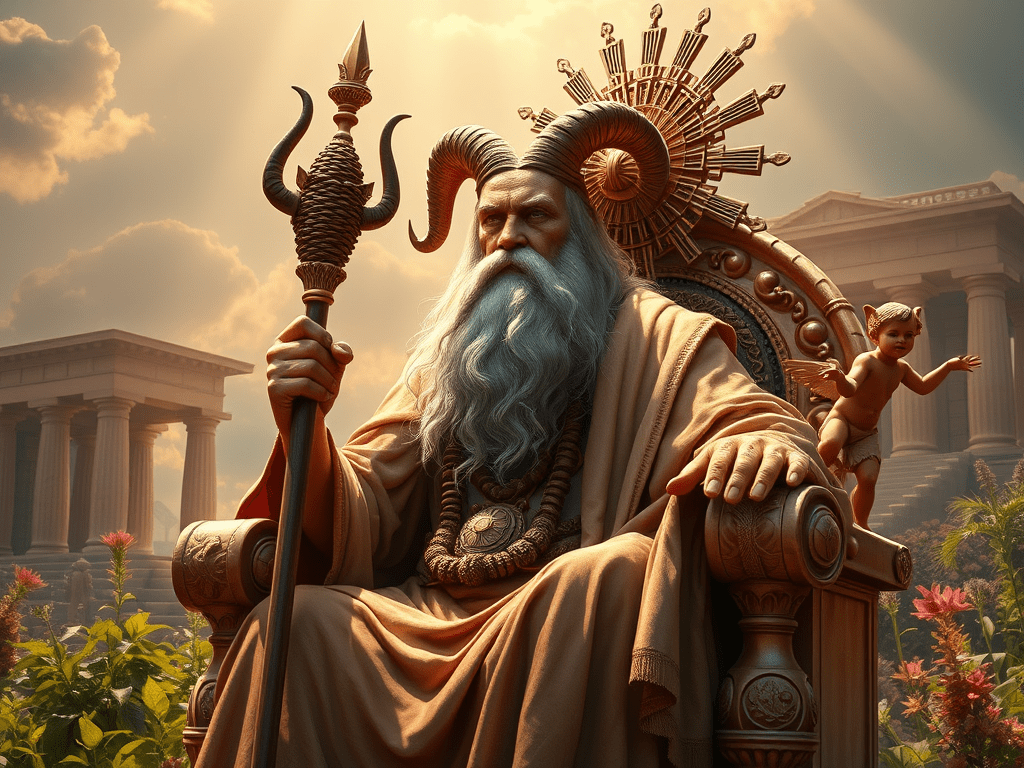
So into the chaos of history is where I went today. I wanted to know what other pantheons have been nearly lost to time. In doing this, I found Carthage’s pantheon. Of course, the first thing I stumbled into was another squirrel hole—the Phoenician deities. I’ll have to dig into those next because Carthage’s pantheon is a mix of Phoenician origins and influences from neighboring cultures. The Carthaginians worshipped a variety of gods, and, as everything tends to do, their deities evolved over time.
One of the most significant deities was Baal Hammon, god of fertility, vegetation, and weather. He was often depicted as an elderly figure with a long beard and curling ram’s horns, seated on a throne adorned with cherubs. His staff was sometimes topped with a pinecone or ears of corn, symbolizing immortality and male fertility. A solar disk, occasionally adorned with wings, was often placed near his head, similar to Egyptian bas-reliefs. His presence in Carthaginian religion was commanding. What intrigued me most at first was his name—Baal Hammon. I thought, “A god with a first and last name? That’s rare.” But I was soon to find out that it wasn’t a first and last name at all, but rather a title and identifier, reinforcing his role as a supreme god rather than distinguishing him as an individual.
His consort, Tanit, was equally powerful and, in some ways, even more revered as time went on. She was linked to motherhood, life, and prosperity, and her presence appeared in inscriptions before Baal Hammon’s, suggesting she may have acted as a divine intermediary. Tanit was depicted in various ways, often tied to palm trees, lions, doves, and olive trees. Some images show her in armor, holding a spear or riding a chariot, emphasizing her protective and warrior-like traits. She was also connected to the moon and fertility, and her emblem—a triangle with a horizontal line and a circle above it—became widely recognized. You could find her image carved into temples, stamped onto coins, and etched into sacred spaces. She wasn’t just a goddess; she was an enduring force.
Other gods and goddesses filled Carthage’s pantheon, each carrying their own significance. Melqart, originally a Phoenician deity, was often equated with Hercules. He became a patron of traders and seafarers, and Carthaginian generals—including Hannibal—swore oaths to him. Eshmun, associated with healing, was identified with Asclepius in Greek traditions. Reshef, tied to fire and lightning, was connected to Apollo, while Rasap took up the mantle of war deity. Hawot, god of the dead, had a place as well—because what is a pantheon without a god of death? Then there were Hudis and Kese, representing the new and full moons; Kusorit and Kusor, linked to intelligence; Semes, the sun goddess; and Shadrap, with her connections to snakes and healing.
Beyond these, Carthage had lesser-known deities who shaped daily life and rituals. Baal Iddir, Baal Marqod, Baal Oz, Baal Qarnem, Baal Sapon, and Baal Shamin—whether distinct gods or variations of the broader Baal figure, their presence left an imprint on Carthaginian religious practices. Some scholars argue that Baal Hammon was merely another form of Melqart, while others insist he was a separate entity. Unfortunately, since texts detailing their exact roles are scarce, much of their hierarchy remains a mystery.
Carthaginian religious practices included sacrifices, temple rituals, and the construction of sacred spaces known as tophets—burial sites containing urns that held the remains of animals and infants. Whether these children had died naturally or were part of ritual sacrifice is still debated by scholars, adding layers of mystery to Carthage’s religious customs. That uncertainty only deepens the intrigue surrounding their practices. But one thing is clear—religion was everywhere. Their gods adorned coins, ships, and artwork, and their influence was woven into the everyday lives of the people. Their pantheon didn’t just endure; it adapted, shifting through interactions with other cultures and the passage of time.
Priests held an essential role in maintaining traditions, overseeing ceremonies, and interpreting divine will. Some temples had dedicated priesthoods, while others relied on civic leaders to carry out rituals. Baal Hammon and Tanit played major roles in Carthaginian society, but how did their worship differ from gods of other ancient civilizations? Carthaginian religion was also closely tied to astrology, with celestial movements influencing worship cycles and festivals. The moon gods Hudis and Kese, for example, likely played a role in agricultural cycles and navigation.
Carthage’s religious footprint extended far beyond its own borders. As Carthaginian traders and settlers spread across the Mediterranean, they brought their gods with them, establishing shrines and temples in colonies from Spain to Sardinia. Some Punic deities even blended with local gods, creating new hybrid forms that persisted long after Carthage’s fall.
Just this is so much information, so many rabbit holes and shiny things to look at. I have a feeling this is going to keep my mind occupied a bit, to say the least. If it was you diving into this topic, what would you choose to look at next? More details of the life of the Carthaginians? More details of Baal Hammon and Tanit? What caused the fall of this pantheon? What about the pantheons that shared similarities with it—can we trace connections beyond the Greek gods? And where do we still see traces of Carthaginian religious influence today? That could be its own post altogether. So many ways to go, so much chaos to untangle. Where would you dive in next? Feel free to share which aspect of the coming chaos you would choose to explore, listed or not, in the comments below.
 Who am I?
I would love to hear from you!