
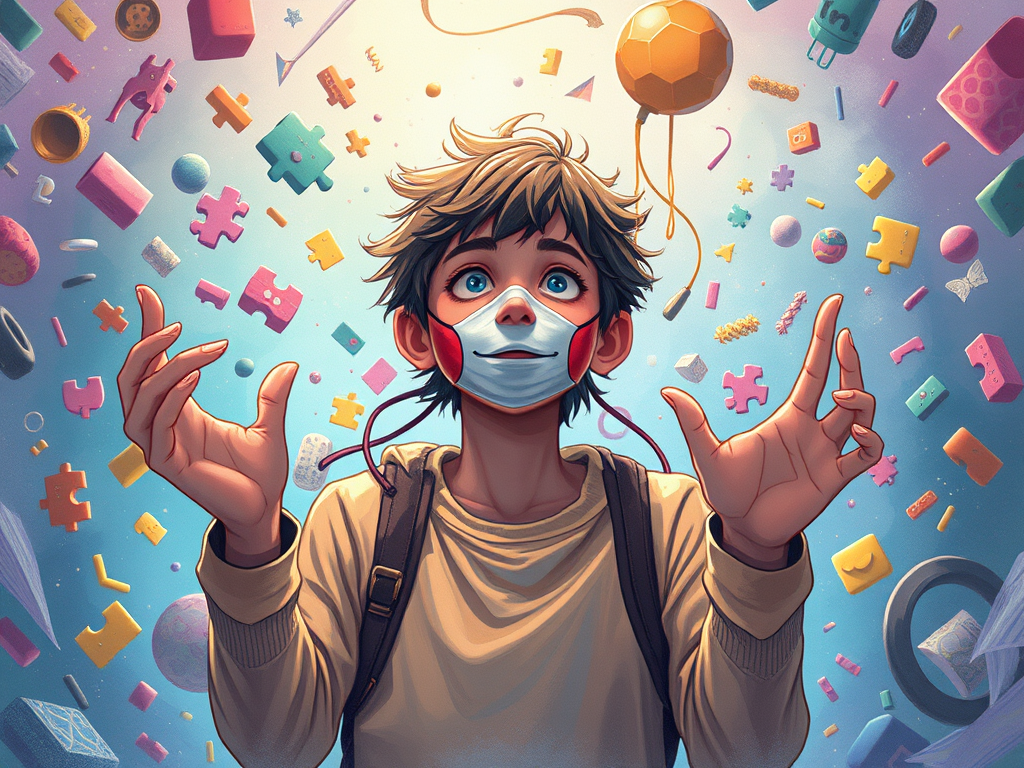
Ah, the strange and fascinating world of AuDHD—where Autism and ADHD merge into one glorious, chaotic symphony of quirks and coping mechanisms. Let me tell you, nothing quite prepares you for the moment you realize your life has been a series of elaborate performances and improvisations under the guise of “normal” behavior. For years, I nodded politely at the psych docs, filed their insights under “probably not me,” and carried on, blissfully unaware of the masquerade I’d perfected. And then, boom—the realization hit me like a rogue Lego brick underfoot: talking isn’t always natural. Sometimes it’s a learned survival skill, a mask crafted so well that even you forget you’re wearing it. Oh, the irony.
So, here’s the deal. Talking as a mask isn’t exactly something you’ll find in your childhood scrapbook captioned “First Words.” For some of us, it’s a tool—one we pick up early to navigate the neurotypical minefield, so early it is in many cases not found till someone is an adult even if diagnosed as a kid. Imagine being handed a script and told to perform your way through life, except you didn’t sign up for the role, and nobody gave you rehearsal time. Turns out, this masking can fly under the radar for years, unnoticed until adulthood, at which point you’re left wondering: “Wait, was I ever truly verbal, or have I just been winging it this whole time?” It’s a tough question, but trust me, the answer is even harder to swallow. Don’t get me wrong, this to me is a good thing. The less drain on my energy the more I can get done and the more my body isn’t hating me.
The epiphany that connected all these dots for me involved hand talking, I actually seen a reel on Instagram that made me recall what I tried to get disproved first with second and third and forth opinions, then research. You know, the gesticulating that makes you look like you’re directing traffic or playing charades with invisible friends. Now, hand talking isn’t exclusive to neurodivergent folks—neurotypicals love a good flourish while recounting their dog’s misadventures—but here’s where it gets interesting. The *why* behind the hand movements is a textbook example of neurodivergent divergence. For me, those dramatic or even subtle swipes and gestures serve as more than punctuation; they’re my lifeline. I use them to center myself when my brain feels like it’s buffering, to find words buried under layers of mental tangles, and to regulate emotions before they stage a full-on mutiny. To the untrained eye, it might look like flair. To me, it’s survival.
And then there’s stimming—the unsung hero of neurodivergent existence. Stimming isn’t just flapping hands or tapping feet. Oh no, it’s a broad spectrum of activities, ranging from hand flapping to, yes, doom scrolling. Wait, let’s pause on doom scrolling for a second. Did you know endlessly scrolling through social media isn’t just procrastination? For some of us, it’s a dopamine-seeking expedition. A treasure hunt for that elusive burst of reward chemicals to keep us going. Gaming fits into this category too—a stim buffet, where sensory engagement and pixelated triumphs deliver us to dopamine nirvana. It’s not just entertainment; it’s therapy, wrapped up in boss fights and glowing achievements.
Here’s the part that really shifted my perspective—the importance of asking *why*. Why do I talk so much? Why do I talk with my hands like I’m auditioning for a bird documentary, or to be on stage? Why do I spend hours gaming or endlessly scrolling through instagram? The answers aren’t superficial—they’re rooted in the mechanics of neurodivergence. My tendency to overshare? Masking. Masking so effectively, in fact, It really made me think about that in an alternate universe where things were truly fair, I might not have been verbal at all. Imagine that—a quiet me, sitting peacefully, not rambling about the history of socks or the existential dread of sandwich choices. It’s almost comedic, isn’t it? To most people it would be no lies there.
Oh, and let’s not skip over the peculiar relationship I have with languages. Here’s the deal: I can understand new languages fairly quickly, absorbing grammar and vocabulary with ease. Speaking them, though? That’s where my brain pulls out a “Closed for Business” sign and I have to really work at it, not being one to give up I keep trying and always will however now I know why I have such issues I can work with it and make it so it isn’t such a drain on my mind and body. It’s as if my wiring prioritizes comprehension over verbal output—a neurodivergent riddle wrapped in linguistic molasses. Maybe it’s connected to the whole “talking as a mask” thing, or maybe my brain just likes keeping secrets. Either way, it’s a puzzle I haven’t quite solved yet but I will have no doubt there.
If there’s one thing this journey has taught me, it’s that there’s a method to the madness. Recognizing behaviors like gaming marathons or dramatic hand gestures as stimming has been liberating. These aren’t random quirks; they’re adaptive strategies—my brain’s way of saying, “Hey, this helps me function.” It’s like discovering the cheat codes to your own operating system, except the codes are written in glitter and you have to interpret them through interpretive dance.
The core to figure out things like this I was taught is to ask why do I do it. Is it some random reason or does it settle/ground you, does it sooth your mind, does it help regulate things? That is the simplest way to put this one. I invite you to really look at yourself closely. Remember like is drawn to like. You may be surrounded by nerodivergent who just are not diagnosed and therefor you think everything is normal because for your world it is. If you have ever wondered and started to dig then odds are something set you on that path. Remember why is the most powerful question there is.
So here’s my advice: don’t dismiss the insights of those psych docs too quickly. Sure, their observations might feel irrelevant at first, but take a closer look. You might just uncover some truths you never knew about yourself. Though if you have been following me for a bit you know I question docs all the time. It is part of Stop Being A Compliant Patient after all. Navigating life with AuDHD isn’t always easy—it’s a balancing act between masking, stimming, and trying not to trip over your own feet. But it’s also a fascinating adventure, filled with self-discovery, unique insights, and moments of humor that remind you just how beautifully chaotic the neurodivergent experience can be.
Embrace the quirks. Celebrate the chaos. And if you find yourself doom scrolling for hours or gesturing with your hands mid-conversation, just remember—you’re not auditioning for a role; you’re simply living your neurodivergent truth, or you just are passionate about the topic. And honestly, that’s more than enough.
I will not lie and say this didn’t shake my world up real good. It actually made me shut down almost completely for a few days. Just because my brain was trying to process that something that is so much a part of life for me is a mask, it drains me more then others. It explains so much of why I get tired so fast especially around other people. Now I need to find a way to adapt to this need, a non-verbal way to communicate that others will get. I am still, truth be told, trying to wrap my brain around this one and you know what? That is okay as well. It is the brain trying to say okay slow down and just let things be in this case. Slowly absorb this one.
 Who am I?
I would love to hear from you!