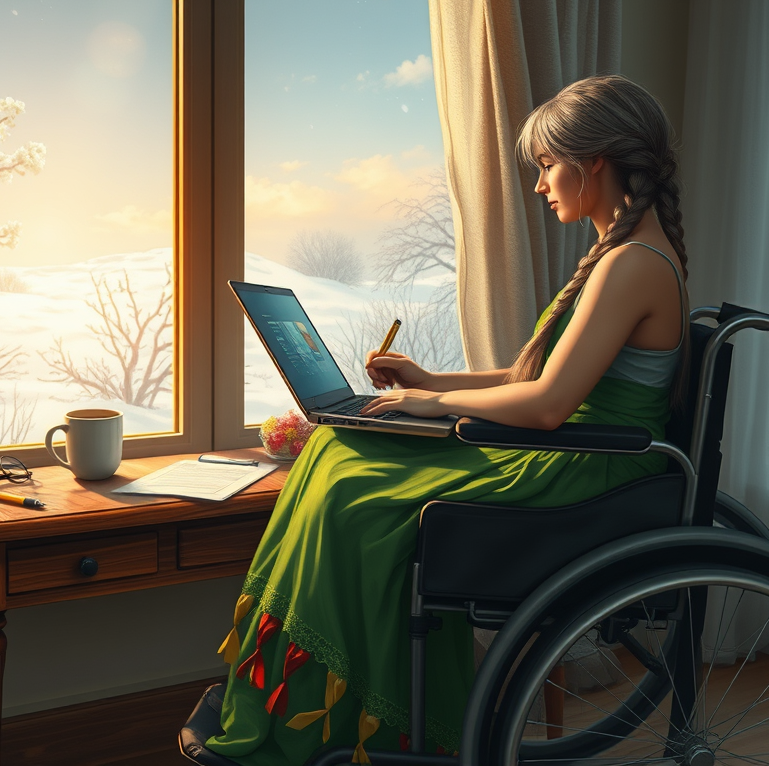

When I hit a creative funk, it feels like wading through fog so thick I half expect to find a lighthouse guiding me back to productivity. The ideas are still there, I’m sure of it—like stars hidden behind clouds—but they refuse to align. Instead, they just sit there smugly, daring me to do something about it. The energy to create vanishes, leaving me stranded in this frustrating creative limbo.
Strangely, writing about my own experiences feels easier during these funks. Journaling doesn’t demand the same creative spark as storytelling—it just requires me to show up and spill my thoughts onto the page. That’s doable, even when I’m running on empty. These funks can last for days or weeks, and I’ve learned not to make promises about my creative writing because, frankly, inspiration is as reliable as a cat coming when it’s called. Some nights, it wakes me up at 2 a.m. with a brilliant idea, and other nights, it’s nowhere to be found, probably off sipping piña coladas on a beach. When it’s the latter, I grab a book and hope someone else’s creativity rubs off on me.
Everything feels harder during these funks, like dragging a bag of bricks uphill. Writing feels like an Olympic sport for which I am woefully untrained. The guilt doesn’t help—my characters are still there, waiting, whispering their stories to me. Sometimes, I can practically hear them: “Oh, sure, just leave us here, unresolved and incomplete. No rush, we’ll just chill in your imagination forever.” I’d argue back, but they’re not wrong. Still, I’ve learned that it’s okay to take a break. Pausing doesn’t mean quitting. If I have to go back and reread a few chapters to get my groove back, that’s just how it is. First drafts are messy anyway, like puzzles with all the wrong pieces.
Editing has its own challenges. Big changes—like switching the point of view—feel about as fun as reorganizing your closet, only to find you’ve made a bigger mess halfway through. But once those heavy edits are out of the way, the rest feels lighter. Tweaking a sentence here, adding detail there—it’s like tidying up instead of starting from scratch. When the fog doesn’t lift, I turn to short stories. They’re bite-sized projects that don’t demand as much commitment, like speed dating for writers. Sometimes, they even remind me why I fell in love with writing in the first place.
These funks are especially brutal when pain confines me to my bedroom. It’s not the lack of sunlight that gets to me—I’m a night owl, after all, and I thrive in the glow of the moon and the soft hum of insomnia. The problem is the isolation. Even a quick “hello” while walking my pup would help, but when those interactions disappear, loneliness creeps in like an uninvited guest that overstays its welcome. Doubts start throwing a party in my mind, and my confidence drops faster than a Wi-Fi connection during a storm. I find myself longing for sleep, not out of exhaustion, but as a way to escape the endless loop of overthinking.
Recently, I came across a piece of advice that struck a chord: “Write what you feel, even if it doesn’t fit your current project. Someday, it will.” I wish I could remember who said it, but whoever they are, they’ve clearly spent some time in the same fog I’m navigating. Writing what I feel—raw, unpolished, and occasionally ridiculous—creates something real. No, this isn’t depression; I know those signs well. This is different. It’s a disconnect, like watching the world through a one-way mirror. I see life continuing around me, but I feel invisible, stuck in my own private bubble of frustration.
I never know how long a funk will last or what it will take to break through it. But maybe, if I embrace the messiness of it, I can turn it into something useful. Even in the fog, there’s always a spark waiting to be found—probably hiding under the metaphorical couch cushions, right next to the remote I keep losing.
How do you cope with creative funks?


I would love to hear from you!