
Trigger Warning: This post discusses mental health struggles, including depression, CPTSD, ADHD, ASD, self-harm, and emotional distress. It contains vivid descriptions of overwhelming feelings and coping mechanisms that may be difficult for some readers. Please proceed with care, and prioritize your well-being. If you’re in crisis, reach out to a trusted individual or a crisis hotline for support.
The storm began with a whisper,
A quiet chaos twisting, pulling.
Each shadow grew heavier, each wave colder—
How do you fight a tempest inside your mind?
Bruises tell a story,
Not of weakness, but of survival.
What happens when the anchor is lost,
When the winds of memory refuse to let you go?
They say storms pass.
But what if this one doesn’t?
What if the eye of the hurricane
Is where I must rebuild?
Several months ago, I noticed my antidepressants weren’t working, nor were the meds for my CPTSD. Without a family doctor, I didn’t mention this to anyone—not because it didn’t matter, but because I felt trapped without options. And without that doctor, I couldn’t get my ADHD meds either, which, paired with my ASD, felt like trying to navigate through a hurricane with no map, no tools, and no hope of shelter.
December, January, and March have always been hard months for me. There’s a heaviness to them—a weight that seems to creep into the air, making every moment feel longer and harder to endure. This time, though, the storm began to build long before those hard months arrived. Back in September, it started as a quiet unease, a whisper of something being off. I brushed it aside. Everyone has bad days, I thought. This was just another one of mine. But the whisper didn’t fade. Instead, it grew louder, gaining strength like the low rumble of thunder on the horizon.
When December hit, the storm had become impossible to ignore. My CPTSD flashbacks weren’t just memories—they were unrelenting assaults, pulling me out of the present and throwing me headfirst into the worst moments of my past. Every detail—sights, sounds, smells—was sharp and vivid, suffocating me in a reality I couldn’t escape. It wasn’t just mental—it was physical. My heart raced, my breath caught, my body tensed, locked in fight-or-flight mode as my mind screamed at me that I was back there, reliving it all over again. And just when I thought I might catch my breath, another wave would hit, dragging me under.
My depression fed off these flashbacks, growing stronger and more oppressive with each one. It wasn’t just sadness—it was an overwhelming void, a complete absence of light that left me feeling hollow and disconnected. I tried to tell myself it was just the time of year, that I’d been through this before and I could get through it again. But I was lying to myself. Deep down, I knew this was different. I wasn’t just struggling—I was breaking. The things that once helped me keep going—finding small joys, seeing the good in things—no longer felt like enough to hold me together.
Meanwhile, my ADHD was wreaking havoc, my mind flitting from one thought to the next with dizzying speed. Random memories, intrusive thoughts, and unfinished to-dos all collided in a chaotic cacophony that only made the storm inside me worse. It was like trying to quiet a room full of shouting voices while standing in the eye of a hurricane. Those distractions often triggered panic attacks or, worse, CPTSD responses, which drained me even further. My ASD craved routine and stability to anchor me, but my ADHD chaos made maintaining any semblance of routine impossible. I was drifting, untethered, with nothing solid to cling to.
This storm wasn’t something I could think or will my way out of. It wasn’t a matter of discipline or determination, of trying harder or staying positive. These weren’t problems that could be solved with retraining my brain or pulling myself up by the bootstraps. They were forces far beyond my control, rooted in the neurochemistry of my brain and the trauma etched into my being. Telling me to “just focus” or “try harder” would have been as helpful as telling someone in a hurricane to control the wind.
The storm fed on itself, each condition amplifying the others in a relentless, self-perpetuating loop. My ADHD heightened my vulnerability to distractions and sensory overload, which often sent me spiraling into flashbacks or panic attacks. Those episodes, in turn, exacerbated my depression, leaving me more exhausted and less able to manage my ADHD or maintain any routines. My ASD, which depends so much on stability, was thrown completely off balance, amplifying my anxiety to unbearable levels. And in the background, my CPTSD loomed like a constant shadow, its sharp edges cutting deeper with every flashback. Each wave of the storm grew stronger, until it felt like I was standing in the center of a whirlpool, being pulled down with no hope of resurfacing.
Out of this chaos came the compulsion to self-harm, rising like a dark undercurrent in the storm. It wasn’t a thought—it was a need, visceral and consuming. The compulsion didn’t ask for permission; it demanded relief. For years, I’d turned to cutting when my emotions became too big to contain, when the weight of it all felt too heavy to bear. Cutting had given me a way to see those trapped emotions leave my body, to externalize the pain that I couldn’t put into words. This time, I managed to avoid picking up a blade, but it was a razor-thin line I walked. The elastics around my wrists became my lifeline and my torment. I snapped them hard enough and often enough that they left bruises—a desperate attempt to satisfy the compulsion without crossing a line I feared more than anything else. But it wasn’t enough. It was never enough. The storm continued to rage, and I felt myself slipping closer and closer to its depths.
Finally, I broke. At an appointment with my dietician, I found myself saying the words that felt impossible to say: “I need help. I’m on the edge of a mental health crisis.” Admitting that felt like exposing myself to the elements, standing vulnerable and raw as the storm roared around me. But it also felt like the first step toward finding shelter.
She listened. And more importantly, she acted. She got me in to see their therapist immediately—someone I already trusted, even though her specialty lay in other areas. Trust was what I needed most in that moment, someone who could hold the space for me without judgment, someone who saw past the chaos and pain to the person trapped beneath it all.
I’ve always known what to do in situations like this. I’ve spent years learning and building tools to cope. But this time was different. The compulsion to self-harm was deafening, and the storm raging inside me had left me hollowed out and drained of the strength I needed to fight it on my own. My ADHD pulled me into rabbit holes of distraction, triggering panic attacks or flashbacks that would spiral out of control. Each CPTSD response left me raw and vulnerable, feeding my depression, which in turn made it nearly impossible to regain control of my ADHD. My ASD craved routine and stability to ground me, but the storm made maintaining any sort of routine feel impossible.
My therapist reminded me of the crisis line and helped me set a deadline to call it—two days at most. She understood me well enough to know that reaching out a third time would require me to dig deep, that I would need to muster every ounce of strength I had left to say the words “I need help” again. The first time, with my dietician, had been brutal. The second time, with my therapist, had been excruciating. Each time I said it, it felt like another wall crumbling, exposing pieces of myself I’d fought to keep hidden.
She followed up with me to ensure I’d made the call. But she didn’t stop there. She took it upon herself to contact the crisis line and explain my triggers. Walking into medical places as a patient is always triggering for my CPTSD. I have coping skills to manage, but in the state I was in, I knew those skills wouldn’t be enough. My fear of being misunderstood—of encountering a professional who didn’t grasp how ASD works in adults, let alone in women—was paralyzing. The idea of explaining every dark, complex detail to someone who might dismiss it felt like an insurmountable mountain to climb.
But my therapist paved the way. She made sure the groundwork was laid so that I wouldn’t have to face that mountain alone. She checked in with me three hours before my appointment, offering a pep talk and ensuring I was ready to go. By the time I arrived—an hour early—it took every ounce of strength just to walk through the doors. I was throwing up, snapping my elastics harder than ever. It wasn’t until my service dog settled me enough that I could even think about going inside. Four paws to the ground unless tasking is the rule, but in that moment, she was tasking hard, riding in my lap, the only thing keeping me from retreating to my car and curling up in defeat.
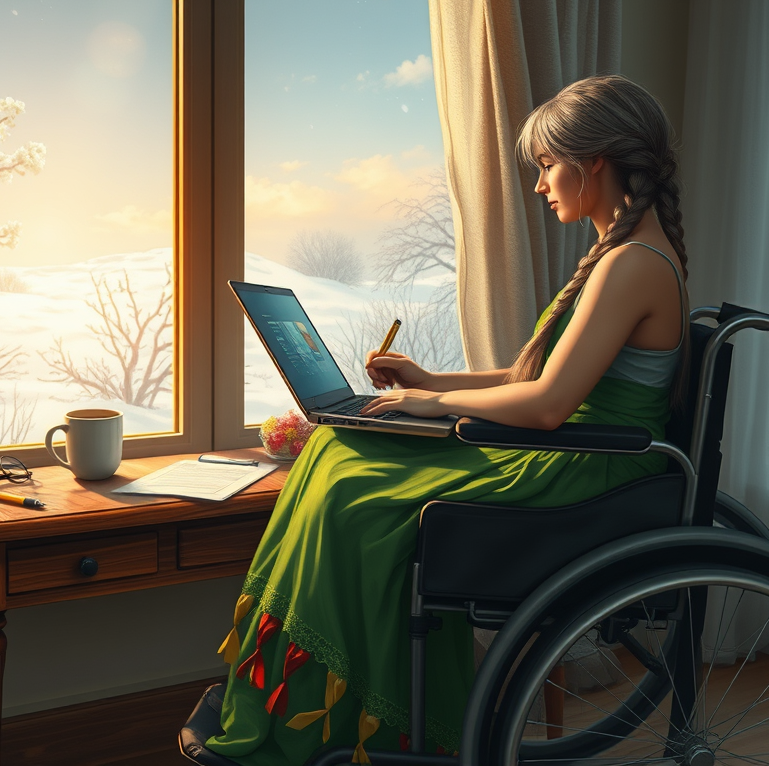
Getting inside was its own nightmare. Navigating with a wheelchair felt impossible, and I almost turned back several times. But I didn’t. Somehow, through sheer stubbornness or the faintest spark of hope, I made it inside. And once I was there, I discovered that my appointment had been carefully planned to minimize triggers. I was seen immediately. There were no other patients, no long wait, no additional stressors.
And then, for the first time in what felt like forever, something went right. The mental health professional who saw me understood me—truly understood me. More than that, he knew how to help. He adjusted my medications, adding one I should have been on for years—something that not only supported the antidepressant but also helped manage the behavioral impacts of ASD. It was as though, for the first time in months, someone had handed me an umbrella in the storm. It didn’t stop the rain, but it gave me the slightest bit of shelter.
By February, I began to feel the first hints of relief. The storm didn’t dissipate overnight, but it started to ease, little by little. And in those moments of calm, I found myself reaching for something I hadn’t felt capable of in months: hope. I made my first post here, beginning a healing journey that’s far from over but is, at least, moving forward. Every post I make, no matter the topic, is a piece of that journey—me healing bit by bit, finding my way back to myself.
Coming back from this will take time—time to even get back to where I was before the spiral began. Saying that out loud is daunting, acknowledging it even more so. But it’s the truth, and truths like this don’t need sugarcoating. They’re raw, they’re heavy, but they’re mine. Yet here’s another truth I’ve learned to hold onto: this website, this space, has brought me to a better place than I’ve ever been. It’s shown me that healing isn’t about racing to a finish line; it’s about learning, growing, and rediscovering yourself bit by bit.
A big part of that has been accepting the parts of myself that are simply who I am, even when society tries to tell me otherwise. It’s a process I’m learning to embrace every single day right here in this space. This website has become more than a platform—it’s a reflection of my journey toward self-acceptance and growth.
If there’s one thing I want you to take away from my journey, it’s this—you are never alone. There is someone out there who understands, someone who sees you, gets you, and is ready to stand beside you when the storm feels overwhelming. Don’t give up looking for them. Don’t stop reaching out. Because when you find that person—or when they find you—it can change everything. And you deserve that.
 Who am I?
I would love to hear from you!