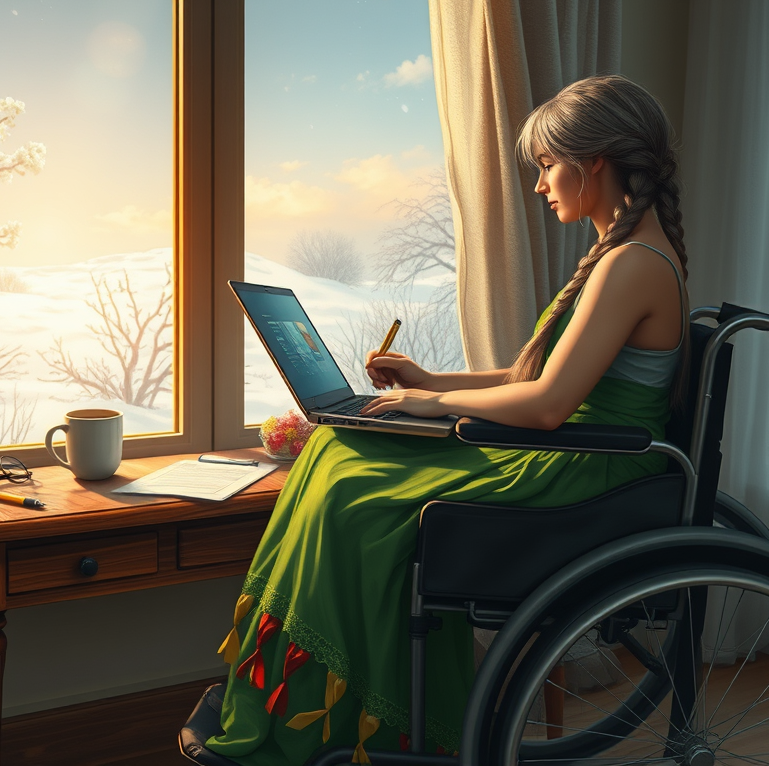

Hello, lovely readers! Did you know that butterflies can see colors we can’t? Their eyes are equipped to detect ultraviolet light, revealing patterns on flowers invisible to us. Imagine having a secret world of colors only you could see—how magical is that?
Yesterday was… how do I even put it? Let me tell you what happened after the post Surviving Medical Negligence: My Story Part 1, and maybe by the time I’m done writing, I’ll know what word to use for what yesterday was.
If you read part one, you know there were many issues in December when my pulmonary emboli were found in both lungs by the ER team. Which, honestly, is an understatement even with those words. I’ve been stressing about how to get the follow-up scan—the only thing I was told to do in regards to care for such a dangerous medical situation. No walk-in clinic would send me for a nuclear scan, let alone under sedation, which is absolutely necessary for me. And let’s make no mistake about the fact that it is a need. I was scared to research online—one of the first times I didn’t immediately start learning about something. I was scared of what I’d find because I know how bad this is. Pulmonary embolisms are silent killers. In a way, my asthma attack saved my life because it set off some reaction in my body so the breathing wouldn’t calm down. Funny how something that feels like drowning can actually be a lifeline.
I’ve been going to meet-and-greets with doctors for two years now and haven’t been able to find one that meets even my lowest standards until I can find the right one. Since the ER visit, I’ve been going to one every week, burning myself out badly, with this ticking time bomb constantly at the back of my mind. A little while ago, my doctor from the bariatric clinic and I had a follow-up—the first one since December. She was not a happy camper, to say the least. She referred me immediately to the thrombosis clinic, which was great news for me. Finally, I could cut back on how often I was doing meet-and-greets. Did I mention she wasn’t a happy camper?
A few weeks ago, they called and booked me in for April 29, 2025, at 15h00 (aka 3 p.m.—yes, all my clocks are set to 24-hour time). We set up the appointment for when it would be the quietest, when I’d be awake given my random sleep patterns. This was to mitigate my CPTSD, my extreme anxiety that feeds off of it, and my ASD, because of course the other two are filled with extra sensory input. I was eager for this appointment—to find out what was going on, to learn more. By this time, though, I’d dug and dug and dug some more because I was given no other choice. I thought everything would go great.
Boy, was I wrong. The night before, my watch kept tripping off the high heart rate alert. I shrugged it off, convinced it was just because I’d had a hotter-than-usual shower. But my body already knew what my mind hadn’t pieced together yet—that I was teetering on the edge of an abyss. Sleep was elusive, as always. I curled up with book one of the Black Dagger Brotherhood series, letting its fictional world try to drown out the chaos of my own. Eventually, sleep came—but only just. Less than six hours later, I was awake again. My heart was racing, my body heavy with exhaustion, but my mind refused to grant me peace.
As the hours ticked by, I felt the storm brewing inside me. Panic attacks started hitting like waves at 10 a.m., each one growing stronger, eroding any sense of control I thought I had. By noon, they were relentless—every breath felt like it was being dragged through a quagmire of fear. My chest was tight, my skin clammy, tears carving hot trails down my cheeks that never seemed to stop. My thoughts raced faster than I could catch them, tripping over each other in a frenzy of dread and helplessness.
Even texting people felt futile, like screaming into a void, desperate for something—anything—to pull me out of the spiral. My service dog stayed glued to my side, her steady presence fighting to tether me to reality while my mind spun further and further out of control. The seconds dragged like hours. The weight of the panic was suffocating, a crushing tide I couldn’t fight off. I was holding on by the thinnest thread, trying to keep myself from unraveling completely.
Meanwhile, I stayed on hold with AISH, the interminable minutes only amplifying the chaos inside my head. By the time someone finally picked up at 13h00, my voice was trembling, cracking under the weight of emotions I couldn’t contain. I tried to explain, to spill out everything that was tearing me apart, but even the words felt inadequate. How do you convey the feeling of drowning while standing in your living room? The cab was scheduled to arrive at 14h15 at the latest. I took more Ativan, desperate for relief, and scrambled to finish getting ready. My mind was chaos—every action felt like I was wading through molasses, slow and disjointed. I don’t know how I managed to remember everything I needed.
By the time I made it outside, I was already battling the rising tide of panic, even after taking 2 mg of Ativan—a dose that normally would have me coasting in calm waters. But not today. The cab was just a minute away, and I felt a flicker of relief, thinking I might be on my way soon. That relief was short-lived. The cab sat there for 15 minutes, showing up at 14h30 instead of the 14h15 I’d been told. I was going to be late. My carefully planned buffer—the one I’d crafted to account for AISH paperwork, navigating the unfamiliar hospital location, and even the time it took with my chair—was crumbling.
The cab driver was on the phone the entire time, speaking loudly enough to shatter any semblance of calm. It’s like my anxiety said, “Oh, this is my cue!” and cranked things up another notch. And then came the flashbacks—December, the ER visit, the suffocating fear that had been locked away in some mental vault. It all spilled out in disjointed images and feelings, hammering at my already fragile resolve. I reached for another milligram of Ativan, knowing this was a landmine I’d stepped on. The closer we got to the hospital, the harder it was to breathe, as though every moment dragged me deeper into that flashback.
By the time I reached the clinic, I knew I was spiraling—and I also knew I’d mask through the entire appointment, wearing the over-talkative, fake smile like armor. I recognized the pattern. Hide the chaos during the appointment, and then crash harder afterward. It’s like my mind has a personal vendetta against me, ensuring every trigger is amplified to maximum capacity.
The appointment itself was a lifeline wrapped in barbed wire. The doctor was amazing—empathetic, thorough, and he let me record the session, which I knew I’d need because my brain was swimming too much to retain anything. We discussed how my lack of mobility made blood thinners a necessity, which wasn’t uncommon for people using wheelchairs. He prescribed the lowest maintenance dose and reassured me there shouldn’t be any issues moving forward. That should’ve felt like a win, but my mind refused to let me celebrate. Instead, it kept gnawing at the ER debacle—how I should’ve been told that stopping certain medications could worsen clots. If it hadn’t been for my incredible pharmacist catching it, who knows what could’ve happened?
As I left the clinic, I called for a cab to take me home, specifically one with a ramp this time. I knew I wouldn’t be able to safely transfer without it—I was in too much pain, too unsteady. Even standing felt like an Olympic feat at this point, and I wasn’t about to risk another incident. My body had already reached its limit, but my mind hadn’t stopped clawing at me. Anxiety was still dancing around, refusing to back down. I could feel the meltdown creeping up on me, like a shadow slowly overtaking everything. Writing this helps calm me down, I thought. It did… but only a little.
Then came the gland incident with my pup. A gross but necessary task that was marked on the calendar for the weekend. I was running on fumes, teetering somewhere between autopilot and meltdown. The PTSD was starting to calm, but the anxiety was stubborn, clinging to me like static. All I wanted was to lie down, curl up with a book, or just sleep. But I couldn’t let my girl suffer, so there I was, bent over in the tub, cleaning up the mess. My calves were holding her up while my roommate helped with her harness because she doesn’t like getting it done—though she thanks us afterward. Always the polite pup, even after all the drama.
And then my body gave out. The pressure in my head built like a freight train, each second amplifying the sensation, as if my skull were caught in a vice that kept tightening. My hearing dulled, sounds around me distorting into a low, echoing hum, like I was underwater. The world began to tilt—not just physically, but perceptually—as though gravity itself couldn’t decide which direction to pull me. My vision blurred at the edges, darkening and narrowing, the room slowly collapsing into a tunnel that grew smaller with each heartbeat. A sheen of cold sweat slicked my skin, making every part of me feel clammy, almost detached from the body I was struggling to keep upright.
My legs felt like they didn’t belong to me—weak and trembling, as though they might dissolve from under me at any moment. My heart pounded so hard it echoed in my ears, and my chest felt like a drum being struck with the heaviest mallet. My mind was fighting desperately to assess the situation, clinging to fragments of logic amid the fear. If I fell forward, there was the mess in front of me—a gross reminder of why I was even bent over in the first place. But falling backward meant risking a hard hit to the taps, and I was already on blood thinners if I hit my head that meant ER. That thought alone sent another icy wave of dread crashing through me.
“I’m going down,” I forced out, my voice thick and slurred, almost unfamiliar to my own ears. My roommate acted quickly, pulling my service dog out of harm’s way before turning his attention back to me. The effort to speak had drained what little strength I had left, and I surrendered to gravity. Desperately, I aimed to fold over myself, trying to land on my backside while curling my torso forward over my legs. It was an awkward, clumsy attempt at control, but it was the best I could muster in the moment. It worked so I’m not going to complain.
The fall felt both instant and endless, a clash of inevitability and resistance. When I hit the floor, it wasn’t graceful—but it wasn’t catastrophic, either. I didn’t fully black out, but I came terrifyingly close, every fiber of my being clamoring for oxygen and stability. My roommate took over, finishing up with my girl while I fought to come back from the edge of consciousness. He peppered me with questions, but I could barely muster the energy to respond. Even simple movements, like reaching for the tub’s grab bar, felt insurmountable. My body was spent, my mind frayed, and all I wanted was the sanctuary of my bed.
When I finally made it there, curling up under the covers felt like a small victory in itself. But the battle wasn’t over. My head spun, a dull ache pounding behind my eyes, and I was sweating when I shouldn’t have been. My thoughts churned sluggishly, like a computer with too many tabs open. The realization dawned slowly—my sugars had probably tanked. The anxiety, the panic, the sheer chaos of the day had burned through every bit of fuel I had left. I managed to grab a can of pop, the cold sweetness flooding my system almost immediately. A PB&J sandwich followed, stabilizing the crash enough to pull me back from the edge.
But even now, I’m still teetering. That fainting feeling left for a while but crept back in like an unwelcome guest. My anxiety hasn’t let go, and I’m loath to take more Ativan, even though I might need to. I haven’t spiraled this badly in years, but here I am—walking a road I know all too well. At least I know the road so I know it will get better. Tonight, I’m keeping candy and pop next to my bed, just in case. The thought of going back to a hospital because I didn’t drink the pop and fell is enough to make me shudder.
Yesterday was hell. But writing this? It’s something. It’s a step toward calm, even if calm feels a little out of reach right now. Sometimes you just need to get it out of your system in a way that works for you. For me that is you. Thank you for reading yet another long post. If you figure out why I keep running into issues with drs please let me know. Is it because I won’t let things slide and advocate for myself or something? argh.
2 responses to “Surviving Medical Negligence: My Story Part 2”
-
-
I agree that I should not have to fight like this to get the care I need. I often wonder if I would have some of the issues I do have if I did get proper care and far less stress trying to get it. Sadly though this is not uncommon, not by far. This is why I put my stories out there so awareness of this issue can come to light. I am lucky with having enough of a medical background that I can recognize when it is needed and how to fight back. Yet it takes such a heavy toll.
LikeLike
-


 Who am I?
Leave a reply to Siearra Frost Cancel reply