
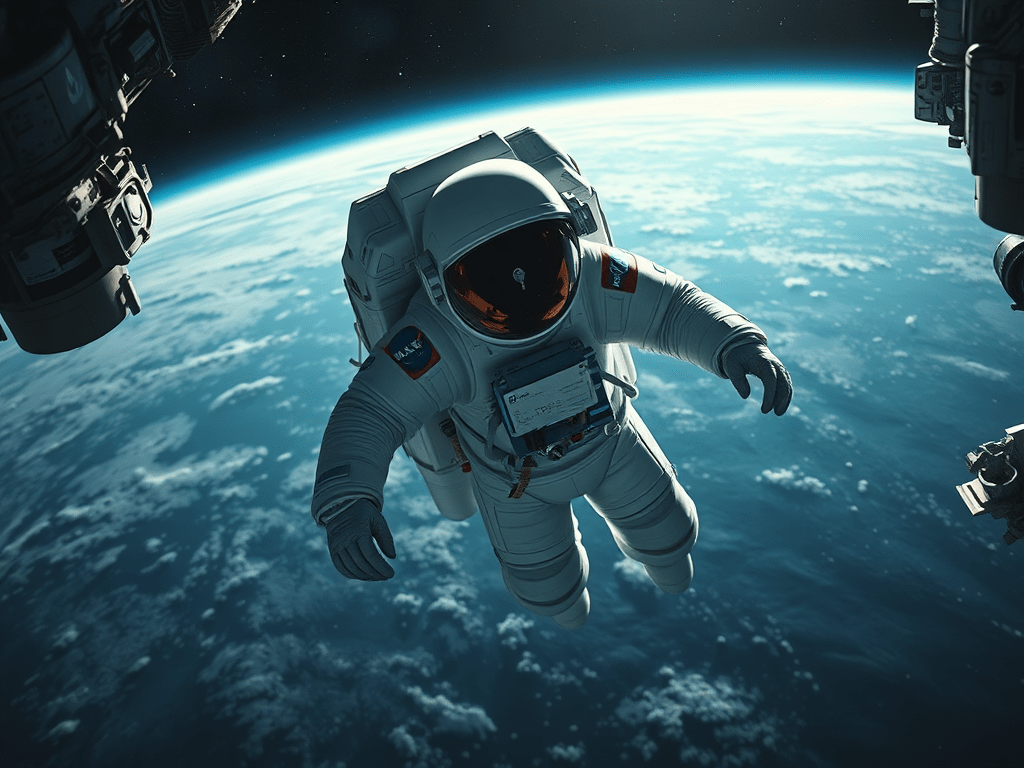
During sleep, I had an idea about exploring space. Although this is the only detail I recall, it inspired today’s topic.
Picture yourself drifting off to sleep and waking up amidst the stars, floating through the endless darkness of the universe. How thrilling would it be to reveal the secrets hidden beyond our planet? From observing far-off galaxies to contemplating whether we are alone in the cosmos, space exploration sparks a wonder and curiosity that captivates us.
Let’s dive into the chaotic, awe-inspiring realms of space travel, the latest breakthroughs, and the future of venturing into the unknown. Whether you dream of stepping foot on Mars or just admire the beauty of the night sky, our journey through space promises an adventure filled with mystery, excitement, and a healthy dose of cosmic chaos.
Space is completely silent due to the absence of an atmosphere. Sound waves have no medium to travel through. If you ever wanted to experience this eerie silence, you’d have to visit the International Space Station and participate in a spacewalk (good luck convincing NASA to let you borrow a spacesuit). The ISS has been continuously inhabited since the year 2000, but its development started long before Y2K. Planning began in the 1980s, and the first module, Zarya, was launched in November 1998, well ahead of the feared technology-driven chaos of the new millennium.
At the time, many worried that banking systems would collapse, power grids would fail, and computers worldwide would malfunction when the clocks struck midnight on January 1, 2000. Meanwhile, humans were quietly preparing to live in space full-time, advancing science and technology beyond Earth. Were you caught up in the Y2K panic? Did you genuinely think it was going to disrupt everything, or did it feel like just another overblown doomsday prediction?
Contrasting the tranquility of space is the chaos of space trash. Thousands of defunct satellites and debris hurtle through orbit at mind-boggling speeds, turning low-Earth orbit into a celestial dodgeball game that spacecraft must navigate with extreme precision to avoid catastrophic collisions. Scientists are currently working on ways to clean up the mess, testing technologies like satellite retrieval and deorbiting strategies. For now, it is space’s equivalent of stepping through a LEGO minefield. Instead of plastic pieces scattered across the floor, though, these Legos are moving at thousands of kilometers per hour. Humanity has left a mess floating above Earth, not with empty coffee cups and food wrappers but with abandoned rockets and broken satellites.
Meanwhile, on Mars, rovers like Curiosity and Perseverance are busy scouring the surface for signs of past life and studying its geology. Scientists speculate that life, if it exists, may be hidden deeper beneath the Martian surface, possibly in subsurface water reserves where conditions might be more stable. If that is the case, who knows what Mars residents think of these mechanical invaders digging into their planet? Are they watching with curiosity, annoyance, or planning their own mission to study the weird robots above? Maybe they are just waiting for the right moment to emerge and knock some sense into humanity. Nothing delivers a reality check faster than realizing you are not the most intelligent lifeform in the solar system.
I had no idea that my random pondering about life hidden beneath Mars was an existing hypothesis until I dug deeper into the facts of what the rovers were doing. It turns out scientists have already been exploring this idea, which is both mind-blowing and hilarious.
Since ASD fuels my need for accuracy and detail while ADHD brings the chaos of rapid idea shifts, I have been using AI to help ensure my phrasing stays clear and does not unintentionally misrepresent facts or ideas. It also speeds up the verification process by handling internet searches for me. That way, I can focus on refining my thoughts rather than spending hours digging for information manually.
In another corner of the cosmos, the New Horizons spacecraft gifted us Pluto’s first close-up images in 2015 before drifting further into the great unknown. It is still transmitting data as it ventures deeper into the Kuiper Belt, exploring the icy outskirts of our solar system. Scientists continue to receive valuable insights about distant celestial bodies and interstellar space conditions, expanding our understanding of the farthest reaches of the solar system. What new secrets will it uncover as it travels through this unexplored region?
I could not believe it when I found out a single full NASA space suit costs about twelve million dollars. Most of this cost is in the backpack and control module. I sure would not want to be the one who damaged that suit. Since NASA still reuses suits from 1974, I really wonder about that dry cleaning bill when it comes time to clean the thing. Whoever saw that invoice must have needed a moment to recover.
Space suits have certainly stood the test of time. Even though designs have evolved, certain elements from decades ago remain in use today. The Extravehicular Mobility Unit (EMU), which astronauts have relied on for spacewalks since before I was born, has gone through numerous modifications to improve safety and functionality.
NASA is working on new suits designed by commercial providers, incorporating cutting-edge technology for future missions. The Artemis program will introduce advanced spacesuits specifically tailored for the lunar environment. Since astronaut’s plan to explore the south pole of the Moon to investigate possible ice deposits, these suits must be built to withstand extreme conditions. If they find ice, it will mean water existed at some point on our big nightlight in the sky. With water comes the possibility of life, raising the question: Could the Moon, like Mars, hold some hidden biological secrets? Even if that seems unlikely, it is fascinating to think about.
To ensure these suits can survive the harsh lunar environment, NASA places components into vacuum chambers for testing. They must confirm that astronauts will be protected in extreme temperatures and unpredictable conditions. The idea that a company exists solely to design spacesuits is fascinating. Then again, space itself is full of wonders.
The space industry is growing fast, with multiple companies racing into the market. If this were a cartoon, I could picture my eyes flying out of my head, my body lifting off the ground, and that exaggerated sound effect playing, the one used whenever characters witness something astonishing right about now. So to think it is multiple is nuts.
Companies such as SpaceX and Blue Origin dominate headlines, but many smaller companies are entering the arena too. That explains why space suits cost so much, given the sheer number of hours poured into designing them. How much does just the thread on a space suit cost? Yeesh.
Then there are the companies specializing in different aspects of space. Axiom Space is leading the charge with the AxEMU space suit for the Artemis III mission, focusing on mobility, life support, and protection for humans landing on the Moon. Meanwhile, SpaceX, Blue Origin, and others are working on landing systems and spacecraft for upcoming lunar missions.
This industry is not shrinking anytime soon. It is the kind of thing worth investing in, almost like buying stocks in Ford when the company was still in its early years. Just as the car industry has companies dedicated to engines, safety features, and interior design, the space industry has specialists in space suits, spacecraft, habitats, life support, and even lunar infrastructure.
Wait, lunar? As in working on Martian and Pluto suits too? Mars makes sense since we are already sending rovers there and leaving broken ones behind, but has anyone seriously considered Pluto? If so, that is a whole other level of ambitious.
Collins Aerospace is one company developing technology that could be adapted for human exploration of Mars. Their work focuses on spacesuits designed for microgravity environments, such as those on the International Space Station, and partial gravity environments like the Moon and Mars.
NASA’s exploration approach, known as Moon to Mars, is structured to make future Mars expeditions more efficient by scaling up technology already in use for lunar missions. Collins Aerospace has been testing next-generation spacesuits for spacewalks, aiming to replace the long-standing extravehicular mobility units (EMUs) currently used on the space station. These suits are designed to be lighter and more flexible, improving astronaut mobility and safety.
To ensure these suits function properly in space, Collins Aerospace has conducted tests in microgravity environments, including parabolic flights that simulate weightlessness. Their goal is to develop a suit that can transition from space station operations to lunar and eventually Martian missions.
NASA encourages innovation by working with multiple providers, allowing companies like Collins Aerospace to contribute to future exploration efforts. This approach ensures redundancy and expands capabilities for long-term space missions.
Thinking about all these advancements, it is wild to consider how far space exploration has come. If you had to pick a space-related technology to invest in, would it be suits, spacecraft, or something entirely different?
Gravity is not the same everywhere, which means different environments require different spacesuit designs.
First, we need to look at free fall. The International Space Station is constantly moving toward Earth’s surface; however, due to the speed it is moving forward, which is incredibly fast at 28,000 km/h or 17,500 mph, it keeps missing Earth instead of crashing into it. This forward motion allows it to stay in orbit.
Astronauts inside the ISS experience weightlessness because they are falling at the same rate as the spacecraft. Since there is no solid surface beneath them pushing back, like the ground on Earth, they feel like they are floating. This is called microgravity, meaning gravity is still present, but its effects are significantly reduced due to the orbital free-fall motion.
Now, compare this to planets like the Moon, which has one-sixth of Earth’s gravity, and Mars, which has one-third of Earth’s gravity. These celestial bodies still have gravity, but it is weaker than Earth’s. That is why when astronauts jump, they go much higher than they would on Earth but still return to the surface because gravity is still acting on them. Unlike the ISS, which is in continuous free fall, astronauts on the Moon and Mars experience partial gravity, meaning they do not float indefinitely; they just fall more slowly than they would on Earth.
Each environment—ISS, Moon, and Mars—requires different spacesuits because the conditions astronauts face vary significantly.
For microgravity on the ISS, astronauts need suits designed for spacewalks, also known as extravehicular activity or EVA. These suits must provide life support, radiation shielding, and flexibility while floating in space. The focus is on mobility in weightlessness, making sure astronauts can maneuver easily without struggling against bulky fabric.
For partial gravity on the Moon, astronauts need suits that allow them to walk, hop, and move efficiently in one-sixth of Earth’s gravity. Lunar dust is also a major issue. It is sharp and can damage equipment, so these suits must have extra protective layers to prevent wear and tear.
Mars presents even more challenges. Its gravity is stronger than the Moon’s but still weaker than Earth’s, so astronauts need suits that allow natural movement without sacrificing durability. Unlike the Moon, Mars has an atmosphere, though it is thin and full of carbon dioxide, so suits must include advanced life support systems. Extreme temperature swings and the planet’s infamous dust storms, which can last for weeks, add further complications.
Companies such as Collins Aerospace aim to create versatile suits that work across different environments by focusing on flexibility, modularity, and durability. Rather than designing entirely new suits for each mission, they are working on spacesuits with interchangeable parts that astronauts can swap based on their destination. These suits still need to provide efficient movement in different gravity conditions while remaining durable enough to handle the abrasive surfaces, radiation exposure, and extreme temperatures that humans are not built to endure. Space exploration is constantly evolving, pushing boundaries and uncovering mysteries beyond Earth. With advancements happening at a rapid pace, what do you think will be the next breakthrough in space technology?
 Who am I?
I would love to hear from you!