
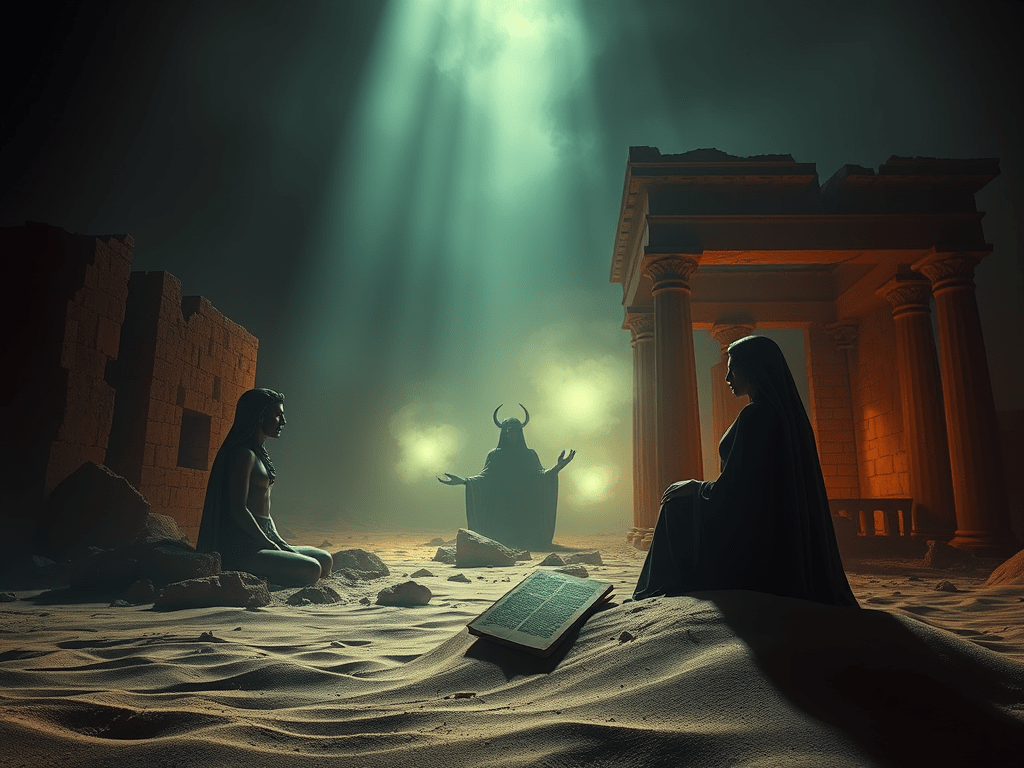
History speaks, but its echoes are never the same.
Warnings against forgetting the past appear in countless variations, echoed by philosophers, politicians, and scholars across time. “Those who cannot remember the past are condemned to repeat it,” said George Santayana. Edmund Burke cautioned, “Those who don’t know history are destined to repeat it.” Winston Churchill put it plainly: “Those who fail to learn from history are doomed to repeat it.”
Three voices. One truth.
Yet history still disappears. Civilizations vanish, their gods fade, their stories reshaped to serve the powerful.
Carthage was one such casualty—erased not just by war, but by deliberate silence. Its gods, once worshiped and invoked, were cast into oblivion along with the city itself.
History isn’t simply lost to time. It is taken, rewritten, silenced. To uncover it is an act of defiance—a refusal to let conquest or convenience bury the past. The forgotten gods of Carthage deserve remembrance—not as myths, but as echoes of a civilization wiped from existence.
In this examination, I felt a deep sense of awe and melancholy—a reminder of how fragile human existence truly is. Each lost deity whispers stories of devotion, struggle, love, and loss. Beneath layers of time, they remain—silent witnesses to forgotten rituals and fading faith.
As I traced their echoes, I felt a connection to the souls who once revered them. They called out in prayer, built temples in their honor, carried their names through time. Now, their voices press against the present, urging us to remember, to honor, to learn from the tapestry of history.
Today, I followed those remnants—the fragments still whispering from obscurity.
Eshmun, the healer, was absorbed into Asclepius. Reshef, the storm-bringer, consumed by Apollo. Rasap, a warrior god, reshaped into Mars—though in that transformation, his essence was stripped away. Mars, the guardian of prosperity, had little in common with Ares, his Greek counterpart, the very embodiment of carnage.
Others simply faded. The lunar gods—Hawot, Hudis, Kese—disappeared, their names swallowed by time’s indifferent tide. Kusor, god of intelligence, may have been erased deliberately. Knowledge is power. Power crushes threats without mercy. Semes, the sun goddess, once radiant, now dimmed beneath Sol, her brilliance claimed and rebranded.
Baal Hammon, Carthage’s supreme deity, waned as his people fell. Tanit, fierce yet compassionate, endured in fragments—woven into North African traditions, molded by time but never truly lost. Melqart, a Phoenician god, found himself bound to Hercules in Greek lore, reshaped by foreign hands, stripped of the identity that once made him whole.
Even the gods who survived did not escape transformation. Their presence lingered, but only as shadows—shrouded, renamed, altered beyond recognition. Their Carthaginian spirit, diluted. Their essence, forgotten.
This is but a glimpse of what was lost. But even in fragments, the weight of erasure is undeniable. The destruction of Carthage was no mere conquest—it was calculated obliteration. Not just of a people, but of everything they believed in. Faith burned alongside stone. Rituals were cast into dust.
“Carthaginian peace”—a phrase that still lingers in history—became synonymous with total subjugation. To enslave a people was not simply to shackle their bodies but to break their minds, severing them from their gods. By dismantling belief, by fostering the perception of divine abandonment, submission became inevitable. Rome understood that war was not only fought with weapons. It was fought through annihilation of identity itself.
Even the language that once carried their prayers—the Punic tongue—was wiped away. The words once etched into temple walls, whispered in sanctuaries, carried in sacred texts, disappeared. Rome did not just take Carthage’s land. Rome stole its voice.
Eventually, Carthage was rebuilt—but not resurrected. What rose was not revival, but replacement. A hollow imitation. A city in name alone. What stood again bore no resemblance to the civilization that had been wiped away. It was not Carthage. It was another Roman colony, another relic in their relentless pursuit of dominance.
Yet total erasure was not to be.
North African folk practices still carry echoes of Tanit. Fertility rituals, protective symbols—fragments of her worship, surviving in the shadows of time. Baal, once mighty, was tethered to Saturn in Roman North Africa. Melqart found refuge in Greek traditions. Faint remnants of their existence still pulse beneath the surface, flickering like embers in the dark.
Archaeological inscriptions across North Africa, Sardinia, and Spain reveal that Punic beliefs did not vanish in an instant. Their sacred texts endured, defying the empire that sought to silence them. Burial customs still carry whispers of Punic rites—the offerings, the prayers, the rituals passed from hand to hand, their meanings softened by time but never truly lost. Even fragments of the Punic tongue survived, drifting through generations, reshaped, repurposed, but never fully erased.
Yet the question lingers: do those who carry these echoes realize their origins? Do they know the gods who once ruled, whose names now linger as mere suggestions in rituals stripped of memory? If not, then Rome’s cultural genocide was successful. It buried Carthage so thoroughly that even its survival exists only in the hands of scholars and seekers.
For centuries, the truth remained buried—until archaeologists unearthed the fragments, uncovering what was stolen, what was rewritten. But even now, Carthage’s pantheon is scarcely remembered, its gods reduced to ghosts.
If Punic traditions had endured instead of falling to conquest, our world today would be unrecognizable.
The Punic language might have shaped North Africa and Mediterranean dialects, rivaling Latin’s influence. Carthage could have stood as Rome’s equal, reshaping the very foundations of Western civilization. Without its fall, the trajectory of religious evolution may have splintered—Christianity and Islam might never have taken the forms we know today, their rise challenged or redirected by Punic traditions.
Consider the recent passing of Pope Francis on April 21, 2025, at the age of 88—a loss felt worldwide because Christianity shaped global history. Now imagine if Carthage had survived. Would Punic faith have carved an entirely separate path? Would history have splintered, giving rise to different gods, different beliefs, different truths?
Governance, law, ideology—so much shaped by Rome—might have been rewritten. The balance of power, the spread of influence, modern geopolitics, all altered.
The Holy Wars. The Knights Templar. The Salem Witch Trials. These are history’s reminders that erasure shapes the future in ways we barely understand. Most people recognize them, whether through school, books, TV, or film. But how many know Carthage? How many recall the gods that might still be worshiped today had Rome failed in its destruction? Baal Hammon. Tanit. Echoes of a pantheon that could have endured.
Perhaps Europe and the Mediterranean would have been built on a more diverse ideological foundation. Rome’s influence might have been challenged, shifting the principles of governance and law. Countless lives erased by history may have remained—each survival a ripple effect changing everything in ways we will never know.
If you’ve never watched Back to the Future, you should. A perfect reminder that the smallest shift can rewrite the future—our present.
Had Carthage survived, the world might have been unrecognizable. Power may have shifted differently. Some of the wrong people may never have gained control. The global economy might have held its stability. Maybe humanity would have achieved a central government—a world less consumed by petty rivalries, less obsessed with peering over the fence into the neighbor’s backyard instead of fixing its own.
So many questions. And answers we will never have.
That doesn’t make it any less fascinating.
History leaves behind fragments, whispers, unanswered questions.
What happens when a civilization is erased so thoroughly that even its echoes barely remain? Can the weight of what was lost ever truly be measured?
Carthage was silenced—but should it remain that way?
Tell me—what do you think would have happened if Carthage had survived? How different would our world be?
 Who am I?
I would love to hear from you!