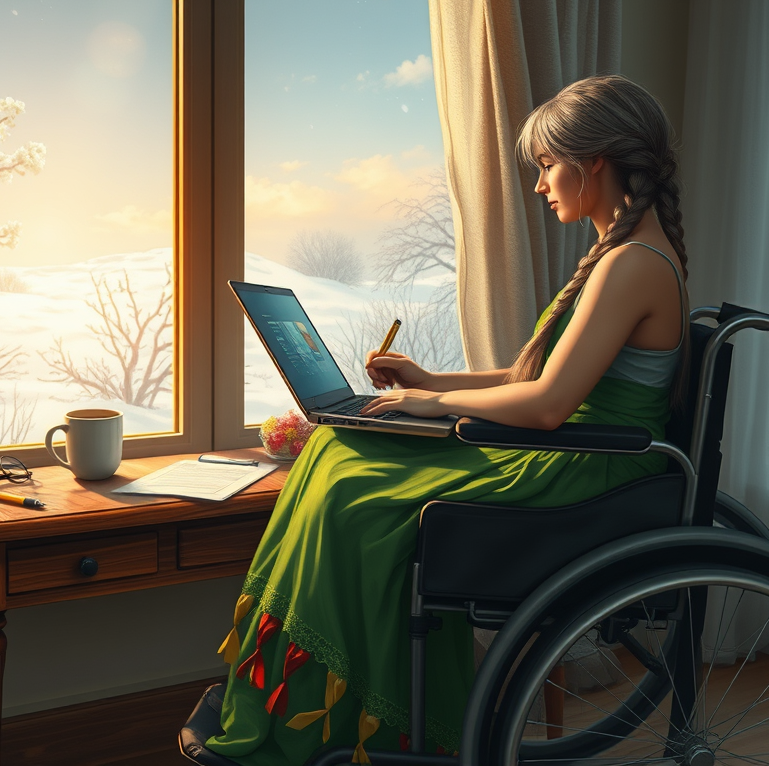


Well, isn’t this just the perfect question for today? It’s sitting at a brisk 10 degrees Celsius outside, which, let’s be real, isn’t all that cold for Northern Alberta. I mean, I’ve survived snowstorms that made my eyelashes freeze together and my car act like it was auditioning for some post-apocalyptic survival movie. So, 10 degrees? Pfft. Easy. Or at least it should be. Except, you know, the whole “my body hates me when it’s cold” thing.
Here’s the deal I actually like cold weather. Really, I do! There’s something magical about the crisp air, the cozy sweaters, and the excuse to drink hot chocolate like its water. Plus, when it’s cold, you can always pile on more layers: sweaters, scarves, socks so thick they double as sleeping bags. But when it’s hot? You can only strip down so much before society gets upset and honestly, even then, you’re still sweating like you’re in some twisted sauna challenge.
But here’s the kicker: cold weather doesn’t exactly love me back. I have fibromyalgia, and let me tell you, winter is like its personal playground of torment. The colder it gets, the more it decides to throw a tantrum. Mild pain? Sure, fine, I can deal with that, I almost do not notice it. But the bad days? Oh, those are like my body is auditioning for a horror movie. The blankets that are supposed to keep me warm? They suddenly feel like they’re made of sandpaper and malice. Clothing? Torture devices, every last stitch. I end up curled up under a sheet begging for sleep to claim me and give me a break.
It’s not just the general aches and pains. Fibromyalgia brings this special guest star called hypersensitivity to the party. Frigid air doesn’t just feel cold it feels like tiny needles stabbing into my skin, as if the wind itself has turned into a sadistic acupuncturist. My muscles? Oh, they like to seize up in protest, locking into knots so tight you’d think they were trying to win some bizarre tension championship. Let’s not forget the fatigue. It’s not just being tired; it’s like my body has decided to shut down all non-essential systems, leaving me feeling like a phone stuck on 1% battery with no charger in sight.
To make things even more exciting (and by exciting, I mean infuriating), fibromyalgia loves to play tricks on my nervous system. It amplifies everything. What might be a mild ache for someone else feels like a full-blown electric shock to me. And the worst part? There’s no predicting it. One day I might manage okay, and the next day, the slightest movement sends waves of pain ricocheting through my body like some cruel chain reaction. Even with medication opioids, no less there are days when all I can do is curl up and wait for it to pass, clinging to the hope that tomorrow might be kinder.
Then there’s the joint pain. Oh, the joints. Some of it’s from an accident thank you, life and the rest? Who even knows. Imagine having a bruise the size of your palm, but it’s buried deep under your hip bone, and it just throbs, waiting for its moment to ruin your day. Now throw in a knee and an ankle that like to stab you with imaginary daggers at the slightest movement. Sitting? Pain. Standing? Pain. Lying down? Oh, you guessed it pain. It’s like my body is running a never-ending talent show for “most creative way to hurt.” Humor becomes a challenge to see how much I can fit into stuff. Even if it doesn’t make sense.
Pain management is like trying to navigate a minefield in the dark while juggling flaming torches unpredictable and with a high likelihood of explosions. My strategy? Start low, go slow, and pray that my body doesn’t throw a tantrum halfway through. It’s like trying to negotiate with a toddler who just discovered the word “why” or “no.” Sometimes it works, and sometimes it ends with me hurting even more though this is rare now that I have a decent idea when not to do this.
First step: the bath or shower. Water therapy has this magical, almost mythical reputation for soothing aches, but let me tell you, it’s a gamble every single time until you can see the pattern and sometimes your body will shake it all up again and you need to figure it out from the beginning once again.
If water fails me and trust me, it often does then it’s time to bring in the electrical cavalry: TENS therapy. You know, those little sticky pads that zap you like a polite, battery-operated gremlin. The idea is that the pulses distract your nerves from their “let’s torture this human” routine. Sometimes it works like a charm, and other times it’s as effective as asking my pain nicely to leave.
If none of the above do the trick, I must start considering medication, but let me tell you, I treat that step like it’s the nuclear option. I begin with the tiniest dose possible so tiny, it’s practically homeopathic and work my way up only if absolutely necessary. Why? Because I’ve got this massive, flashing neon sign in my brain that says, “Addiction: Hard Pass.” Cigarettes were enough of a nightmare, thank you very much. The idea of wrestling with dependency on something stronger? Nope. Not today, well that the mother fuckin addiction idea can just get off my mother fuckin plane. (If you don’t get that reference go and watch snakes on a plane or look up Samuel L Jackson)
Then there’s Ativan. Ah, sweet, reluctant Ativan. I drove my Dr’s nuts when my heart decides to rev up my heart rate to marathon-runner levels like 130-140 BPM levels due to anxiety. Yet I did eventually give in when I learned it can help with migraines, yup migraines you read that right, and a lot of other types of pain. Even then, I take it with the kind of hesitation usually reserved for plunging into freezing water. Medical folks often make the worst patients, and let’s just say I am living proof of that stereotype.
Of course, my caution isn’t just paranoia it’s deeply rooted in genetics. Research has shown that addiction likes to play favorites, and my genes? They’re practically rolling out the red carpet for it. Variations in genes can increase susceptibility to pain medication addiction, and let’s not forget how my genetics with my heritage add to this into this genetic cocktail. Certain studies suggest Native populations may be more prone to dependency, and I’d rather not test how correct they are. The knowledge I have agrees with these studies. Just like lactose intolerance is more common in other heritages.
So here I am, navigating this treacherous landscape of pain management with a methodical approach and a stubborn refusal to let anything pain, pills, or otherwise control me. My body may be a chaos machine, but I’m determined to still be the one steering the ship. Even if that ship occasionally feels like it’s held together with duct tape and sheer willpower.
Let’s dive deeper into the nightmare that is the ER where discrimination and dismissiveness often reign supreme. Some of the worst doctors I’ve ever encountered work in emergency rooms, and instead of helping, they actively make things worse. If you have a psych diagnosis, forget it. That’s their favorite scapegoat, latched onto with zeal while everything else about your condition is ignored.
And the cherry on top? By the time I finally give in and drag myself to the ER, often days later than I should have, I look disheveled. That only fuels their underestimation. They treat me like I’m clueless about my own body, as if desperation and exhaustion erase any credibility I might have. News flash, ER doctors, I worked frontline in the medical field. Underestimating me just gives me more power.
That ASD they use to justify bias actually works in my favor. My special interest is medicine, I read medical studies for kicks and giggles. I don’t flaunt my knowledge, but trust me, it’s there, and I wield it strategically. It is a growing arsenal, after all.
Here’s the kicker, the less detail I reveal about my background, the more these doctors start to wonder what I might know. I carefully craft pointed questions, reference specialists, and drop anecdotes from friends and family with similar experiences. When realization dawns that I am far from ignorant, the look on their faces is priceless. Best part, they think I don’t notice. Their underestimation is their mistake, not mine.
It’s not a cheerful smirk on my end, though, it’s the kind that says, you messed with the wrong person. Because I am more than letters and words on a chart. They don’t see it, thanks to my masking. But what else do I know? Perhaps even who to report their behavior to. The doubt flashes in their eyes, and watching them scramble internally, realizing they can’t get away with dismissing me, is almost satisfying. More amusing still, watching them try one last time to push past their own failure because, hey, why not overload me while they’re at it?
Make no mistake, this isn’t a fight I lose often. I’ve built up an arsenal of strategies to deal with god-complex attitudes, and when necessary, I make a scene. Witnesses are something doctors absolutely don’t want.
I didn’t enter the medical field for the paycheck, I did it because I wanted to help people. So when I see entitled, arrogant doctors dismiss patients, it grates on my already frayed nerves. Since I can no longer work in the field, I channel my expertise into volunteering as a Patient Advocate. In this role, I hold both patients and doctors accountable, though more often than not, it’s the doctors, especially in emergency and niche specialties, who require intervention.
This experience only sharpens my ability to navigate these encounters. I gain so much more information. Hey doc, might want to stop underestimating and being a jerk to nurses, they tell me exactly what I need to fight better. And I think they get their own form of satisfaction watching reality delivered, even if it won’t stick.
Doctors always do this to me. By now, it should be in my chart, and if it’s not, not my issue. Stop assuming. You put lives at risk when you pull that nonsense. I am proof of it. The fact that I’ve never needed admission and always maintained control of my conditions should be enough to rule out psych-related causes.
There’s a rare kind of satisfaction in watching those self-righteous pedestals wobble under the weight of my strategic questions and medical knowledge. Their underestimation of me, my kindness, my sweetness, is their downfall, every single time. Why not use it to verbally knock them down a peg while I maintain an air of saccharine politeness?
Those pointed “questions” that aren’t really questions work wonders, not just for holding doctors accountable but for distracting me from my pain. Even though I wish I didn’t have to fight for care in the first place.
Then, there are the genuinely good doctors. The ones who understand I’m not in the ER by choice. The ones who see me as their best resource for understanding my body. These doctors engage, listen, and even express frustration with their colleagues, remarking how much of their profession needs a reality check.
And honestly, that validation is sometimes what keeps me pushing forward.
However, I get distracted and tend to be cranky when it comes to the medical field with the Doctors and so this tangent always seems to appear. Being something I am passionate about, that is my calling, well they find out what happens and even if I don’t win with them it is called one party consent and the collage of physicians and surgeons love me when I hand over the glaring proof of endangerment of their patients and then some.
So back to the cold and how I feel about it, yea it makes things more painful and draws more tears and makes me have to fight when I shouldn’t need to, well I hate being overheated more sensory wise, and you can only take off so much. The cold can be combatted easier, mitigating these things and I overload less often. I get more from the cold in all areas then the pain at this point can negate the positive by any stretch of the mind. Yea I must go all “Stop being a compliant patient” more then I care for, yet I wonder at times if this isn’t why I get these guys. I don’t take it, maybe I am doing karmas work or giving a warning from the Spirits. Who knows. It comes down to one thing. I feel pain then I am still alive and still here. That is a good thing, so bring on the cold any day.
2 responses to “How Cold Weather and Me Interact”
-
-
I think we all eventually cringe at the idea of cold. Hard not to if we have had any injury let alone a medical issue that makes it worse. I will always take the cold though over heat.
xoxoLikeLike
-


 Who am I?
I would love to hear from you!