
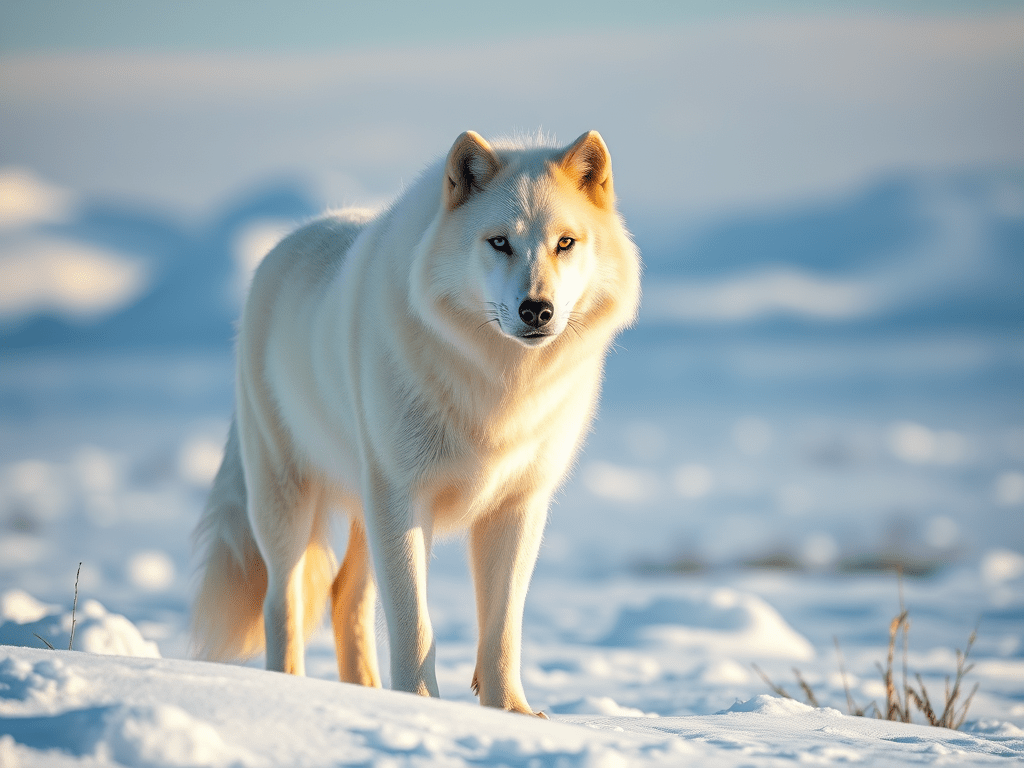
The Arctic wolf is a remarkable creature, perfectly adapted to one of the harshest environments on Earth. Living in the unforgiving terrain of the Arctic Circle, these wolves endure extreme cold, sparse vegetation, and months of near-total darkness during the winter. Unlike their relatives in the Rocky Mountains, who inhabit lush forests teeming with life, Arctic wolves navigate a stark white wilderness where survival depends on resilience and resourcefulness.
One of the most notable characteristics of Arctic wolves is their thick, white fur, which functions as both insulation against extremely low temperatures and camouflage within snowy environments. Their double-layered coat consists of a dense underfur that traps heat close to their bodies and longer guard hairs that repel moisture, ensuring they stay dry and warm even in blizzards. This coat significantly differs from the varied hues of their Rocky Mountain counterparts, whose grays, blacks, and browns allow them to blend into forested landscapes, providing concealment among trees and rocky terrains.
The Arctic wolf’s fur is essential for survival, offering protection from harsh weather conditions and enabling them to remain undetected by their prey. They inhabit some of the most extreme environments on Earth, where temperatures can plummet to -50 degrees Celsius. The white fur not only helps them hunt effectively by blending seamlessly with the snow but also reflects sunlight, preventing overheating during rare, sunny Arctic days. Additionally, their fur-covered paws act like snowshoes, distributing their weight to traverse snow without sinking, while their sharp claws provide grip on icy surfaces. These adaptations make Arctic wolves perfectly suited to their environment, allowing them to thrive in one of the planet’s most unforgiving habitats.
Socially, Arctic wolves operate in smaller packs compared to wolves in more temperate regions, typically consisting of 4 to 6 members. This smaller pack size reflects the scarcity of prey in their environment. The pack’s structure is tightly knit, with the alpha pair leading and ensuring cooperation among members. In the lean Arctic ecosystem, teamwork is essential for survival. While Rocky Mountain wolves might have access to a more abundant and diverse food supply, Arctic wolves must work together to hunt elusive prey such as musk oxen and Arctic hares. Success often depends on careful coordination and the ability to endure long pursuits over vast distances.
Arctic wolves exhibit exceptional skill and strategy during hunting activities. They depend on their acute senses, including sharp hearing and keen eyesight, as well as an extraordinary sense of smell that allows them to detect prey from great distances. Effective communication within the pack is also a critical component, involving various vocalizations, body language, and scent markings. Their hunting methodology frequently involves segregating weaker or juvenile members from a herd, such as musk oxen, and leveraging the terrain strategically, making use of ice floes, snowdrifts, and rocky outcrops to corner their prey.
This differs from Rocky Mountain wolves, who may employ forest cover to ambush deer or elk by using dense foliage and uneven terrain for stealth and surprise. In the Arctic, each hunt demands endurance and determination, requiring persistent effort and cooperation from the entire pack. The challenging environment means that hunts can last several hours or even days, with wolves covering vast distances in harsh weather conditions to find and capture their prey. Additionally, the scarcity of prey in the Arctic necessitates highly efficient and coordinated hunting techniques to ensure the survival of the pack.
Communication among Arctic wolves is a complex system involving howls, body language, and facial expressions. Their howls are uniquely adapted to travel across the expansive tundra, enabling pack members to locate each other over considerable distances. These vocalizations are crucial for maintaining pack cohesion, particularly when members are dispersed while foraging.
Arctic wolves use different types of howls depending on the situation; for instance, long, mournful howls can signal loneliness or a call to gather, while shorter, sharp howls may indicate an immediate threat or alert. The frequency and pitch of these sounds are optimized to carry through the icy landscape, ensuring they reach their intended recipients despite environmental challenges.
Additionally, body language and ear movements play significant roles in conveying nuanced cues about mood, intent, and hierarchical status within the pack. Lowered ears might signal submission or fear, while raised ears can denote alertness or dominance. Tail positions also communicate various messages; a high, stiff tail suggests confidence and authority, whereas a tucked tail indicates anxiety or submissiveness.
Facial expressions add another layer of communication, with subtle changes in eye position, lip movement, and furrowed brows all contributing to the complex social interactions. These sophisticated methods of communication not only facilitate cooperation during hunts but also help resolve conflicts and maintain harmony within the pack.
This advanced communication system highlights their social intelligence, demonstrating that Arctic wolves are highly skilled at interpreting and responding to a wide array of signals from their fellow pack members.
The life cycle of Arctic wolf pups is another fascinating aspect of their existence. Born in late spring, when conditions are marginally less severe, Arctic wolf pups enter the world in a sheltered den, blind, deaf, and utterly dependent on their pack. A typical litter consists of 2 to 4 pups, and their survival depends on the collective efforts of the pack to provide food and protection. As they grow, the pups begin to explore their surroundings, learning essential skills by observing and imitating older pack members. Their fur gradually changes from a grayish hue to the iconic white that defines them as they mature, a transformation that helps them blend into their icy environment.
Adaptability is perhaps the Arctic wolf’s most impressive trait. Their thick fur shields them from the cold, while their compact bodies and shorter legs conserve heat more effectively than their southern relatives. Their large paws act like snowshoes, allowing them to travel efficiently across deep snow. With an acute sense of smell that can detect prey beneath layers of ice and snow, these wolves are expertly equipped for life in the Arctic. Unlike their Rocky Mountain cousins, who may retreat to dens during harsh winters, Arctic wolves remain active year-round, continuously hunting and traversing the frozen tundra.
The Arctic wolf is a marvel of evolution, a species uniquely crafted to thrive in one of the most extreme environments on the planet. Its dense white coat, social structures, hunting prowess, and adaptability all speak to its resilience and ingenuity. Though it shares common traits with other wolf species, the Arctic wolf stands apart as a symbol of survival against the odds, embodying the indomitable spirit of life in the harshest of conditions.
From one species there are so may adaptions and variations based on their habitat that help them survive and live there. After all we all know polar bears probably could take them out as well as a few other artic animals. What is your favorite type of wolf?
 Who am I?
I would love to hear from you!