
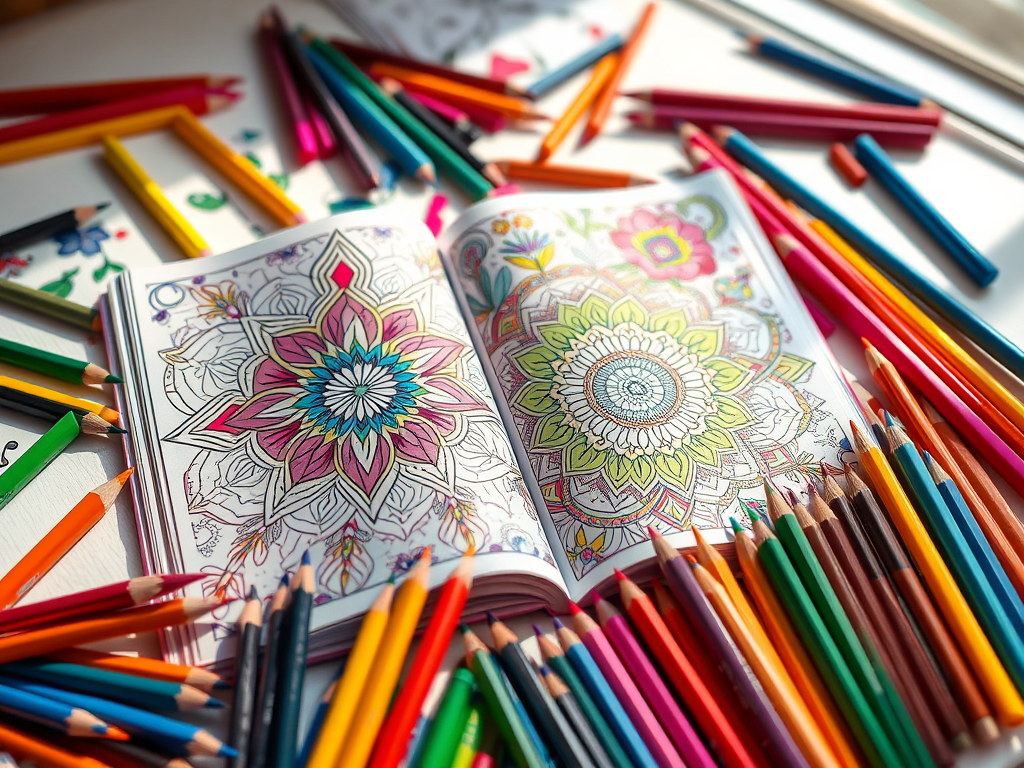
Ah, coloring! It’s so much more than staying inside the lines or deciding which shade of green will make your tree pop although, let’s admit, I take immense pride in crafting trees that look like they’re practically bursting with forest vibes. Coloring is a strange, wonderful blend of creative freedom, mental health benefits, and a touch of chaos (especially when someone has the audacity to tell you orange wasn’t the right choice for your sky). For me, coloring is not just a hobby or an artist’s indulgence it’s a lifeline, a mental health booster, and an unashamedly delightful ritual.
Let’s kick things off with stress relief. You know that feeling when your brain is running laps around all the things you should have done but didn’t? Coloring steps in like an old friend, saying, “Hey, it’s okay. Just focus on this shade of cerulean and breathe.” The repetitive, soothing motion of filling spaces with color has this almost magical ability to calm your nervous system. It’s not just a fleeting escape; it’s a genuine way to manage stress and anxiety. Trust me, I’ve had days where the chaos in my mind felt like a hurricane, and picking up my colored pencils was like finding the eye of the storm. What’s fascinating is how it encourages relaxation without requiring much effort you don’t need to be good at it or even finish the page to feel the benefits. Just the act of coloring can be immensely therapeutic, offering your mind a safe place to land.
Then there’s mindfulness, which is perhaps one of the sneakiest benefits of coloring. Mindfulness a mental state achieved by focusing on the present moment is touted as one of the best tools for mental health. And coloring delivers it effortlessly. You’re not obsessing over deadlines or dwelling on past mistakes; you’re simply deciding whether your butterfly’s wings should be pastel pink or neon yellow (the answer is always neon yellow, by the way). What surprised me the most when I started diving into the science of coloring was how similar it is to meditation. Both activities encourage mindfulness and focus, but while meditation can feel like trying to herd cats (anyone who’s tried to clear their thoughts knows what I mean), coloring is straightforward, forgiving, and wonderfully accessible. It’s mindfulness without the pressure of “doing it right,” which is a win in my book.

Speaking of wins, let’s talk about mood. Coloring isn’t just a pastime it’s a mood lifter extraordinaire. On days when the gloom feels inescapable, coloring steps in to brighten my spirits faster than a surprise delivery of cookies. The act of creating something, no matter how simple or complex, triggers positive emotions. There’s a reason experts say it helps alleviate feelings of depression and improves overall emotional well-being because it truly does. There’s something so satisfying about watching a blank page come alive with color, almost as if you’re reintroducing joy into your own life one stroke at a time. For anyone struggling with mental health, coloring offers a gentle yet impactful way to reconnect with happiness.
But wait coloring isn’t just about emotional well-being; it’s got cognitive perks, too. Imagine this: you’re sitting with a mandala coloring book, surrounded by pencils with names like “Goldenrod” and “Periwinkle,” and you find yourself completely engrossed in those tiny, intricate designs. What you may not realize in the moment is that your brain is getting a workout. Coloring activates the frontal lobe, the part of your brain responsible for problem-solving, focus, and math skills. Yes, math skills although I wouldn’t recommend ditching your calculator anytime soon. The point is coloring improves concentration in ways that feel effortless. I’ve noticed how much sharper my focus has become, not just while coloring but in other areas of life, like untangling the mystery of IKEA instructions (a task that feels nearly Herculean without some cognitive finesse).

Now let’s dive into creativity, the true playground of coloring. Creativity isn’t just about being artistic; it’s about thinking differently, embracing possibilities, and taking risks even if those risks involve using magenta for your lion’s mane. Coloring sparks creativity in the simplest yet most profound ways. You’re constantly making choices, whether it’s mixing colors or breaking away from traditional schemes. That spark doesn’t stay confined to the page; it spills over into your broader creative endeavors, whether it’s writing, painting, or producing innovative ideas at work. Authors and artists alike have credited coloring as a key part of their creative process, which makes me feel slightly less guilty about the growing pile of untouched coloring books in my living room.
But coloring isn’t just creative it’s physical, too. The fine motor skills required for coloring staying inside tiny lines, mastering shading techniques are no joke. These precise movements improve hand-eye coordination and dexterity, which is especially beneficial for people dealing with motor skill challenges or simply looking to keep their hands agile. Personally, I’ve noticed how coloring has steadied my grip and improved my penmanship. It’s like a low-key workout for your hands, except instead of lifting weights, you’re lifting pencils (and occasionally dropping them, because who among us hasn’t accidentally launched a pencil halfway across the room?).

Now, here’s the sleeper hit: coloring as a sleep aid. As someone whose relationship with sleep is more “complicated” than a daytime soap opera plot, I’ve discovered that coloring helps me wind down in ways I didn’t expect. The lack of blue light exposure (goodbye, endless scrolling) combined with its calming effects creates an ideal pre-sleep ritual. Plus, let’s not underestimate the sheer exhaustion that comes from spending an hour meticulously shading a dragon’s wings. It’s oddly satisfying to be tired from focusing on something joyful, rather than the usual mental fatigue from overthinking every decision you’ve ever made.
And let’s not forget the social aspect of coloring, which might sound contradictory at first. Isn’t coloring supposed to be solitary? Well, yes and no. With the rise of coloring groups both online and in-person the activity has become a surprising social connector. These groups offer opportunities to share techniques, swap coloring pages, and even bond over the universal struggle of deciding between “Sky Blue” and “Azure.” It’s a reminder that even seemingly solitary hobbies can foster community, proving once again that coloring is full of unexpected delights.
Finally, let’s compare coloring to meditation, because while both promote mindfulness and relaxation, they couldn’t be more different in execution. Meditation often comes with the pressure to “clear your mind” or “achieve inner peace,” which, let’s be honest, can feel like trying to solve a Rubik’s cube blindfolded. Coloring, on the other hand, is wonderfully simple. There’s no wrong way to do it, no strict guidelines just you, your pencils, and whatever creative whims strike you. It’s like meditation’s laid-back cousin who shows up to the party in flip-flops, ready to have fun without any fuss.
Coloring has this beautiful way of slipping under the radar it’s unassuming yet wildly effective, like the underdog of stress relief techniques. Sure, meditation has long been the golden child of mindfulness, with its promises of inner peace and tranquility. But let’s be honest, trying to clear my mind feels a lot like herding cats frustrating, chaotic, and ultimately impossible. Coloring, on the other hand, is gloriously forgiving. There’s no pressure to reach zen or banish stray thoughts. It’s just me, my pencils, and the occasional existential crisis over whether “Sky Blue” or “Azure” better captures the essence of happiness. Coloring doesn’t demand perfection; it’s simply there, a relaxed companion offering calm without judgment.

Now, take journaling. It’s wonderful, really, pouring your emotions onto a page, capturing your thoughts in neat (or not-so-neat) handwriting. But unlike coloring, journaling requires words, words that sometimes refuse to cooperate. There are days when my mind feels like a jumbled mess of static, and the blank page just stares back, mocking me. Coloring, though? Coloring doesn’t care whether I’m eloquent or coherent. It speaks a universal language of color, and my only challenge is deciding if my dragon deserves neon wings. (Spoiler: it always does.) That simplicity, that freedom from needing to articulate, is a quiet relief.
And music oh, don’t get me started on music. It’s magical, yes, but sometimes too magical. A song can transport me to another world or remind me of something I’d rather not revisit (looking at you, overly sentimental breakup ballads). Coloring doesn’t tug at my heartstrings or drag me down memory lane. It’s rooted firmly in the present, a steady anchor when my mind threatens to drift into turbulent waters. There’s also the added bonus that I don’t have to queue up the perfect playlist or wrestle with ads interrupting my zen. Coloring is my low-maintenance sanctuary.
Let’s not forget exercise, the perennial darling of stress management. I get it the endorphins, the sweat, the triumph of finishing a workout. But some days, the mere thought of putting on running shoes is enough to make me want to hibernate. Coloring, on the other hand, requires no special attire, no gym memberships, and absolutely zero risk of pulling a muscle. It’s like exercise’s more approachable cousin, offering benefits like improved focus and dexterity without making me break a sweat. Plus, the only marathon involved is the one where I try to finish shading a mandala before I lose the will to keep going.

What makes coloring stand out against all these techniques is its delightful unpredictability, its ability to combine creativity, relaxation, and playfulness in one vibrant package. It’s a quiet rebellion against rules orange skies, magenta lions, polka-dotted trees where nothing is off-limits. It’s structured enough to ground me, yet flexible enough to let my imagination run wild. And unlike many other activities, it doesn’t demand anything from me except a willingness to pick up a pencil and start. That, I think, is its real magic. Coloring doesn’t ask me to be a better version of myself. It just lets me be. And if I happen to end up with twenty-seven shades of green on one page? Well, all the better.
So, here’s the deal: coloring isn’t just a pastime, a hobby, or a creative outlet it’s a lifeline. It helps me manage stress, boost my mood, sharpen my mind, and reconnect with creativity in ways I never thought possible. Whether I’m coloring elaborate landscapes or recklessly scribbling outside the lines because rules are overrated, it reminds me that life doesn’t have to be perfect it just needs a touch of color. Or, if you’re me, twenty-seven different shades of green, because moderation is clearly for other people.
 Who am I?
I would love to hear from you!