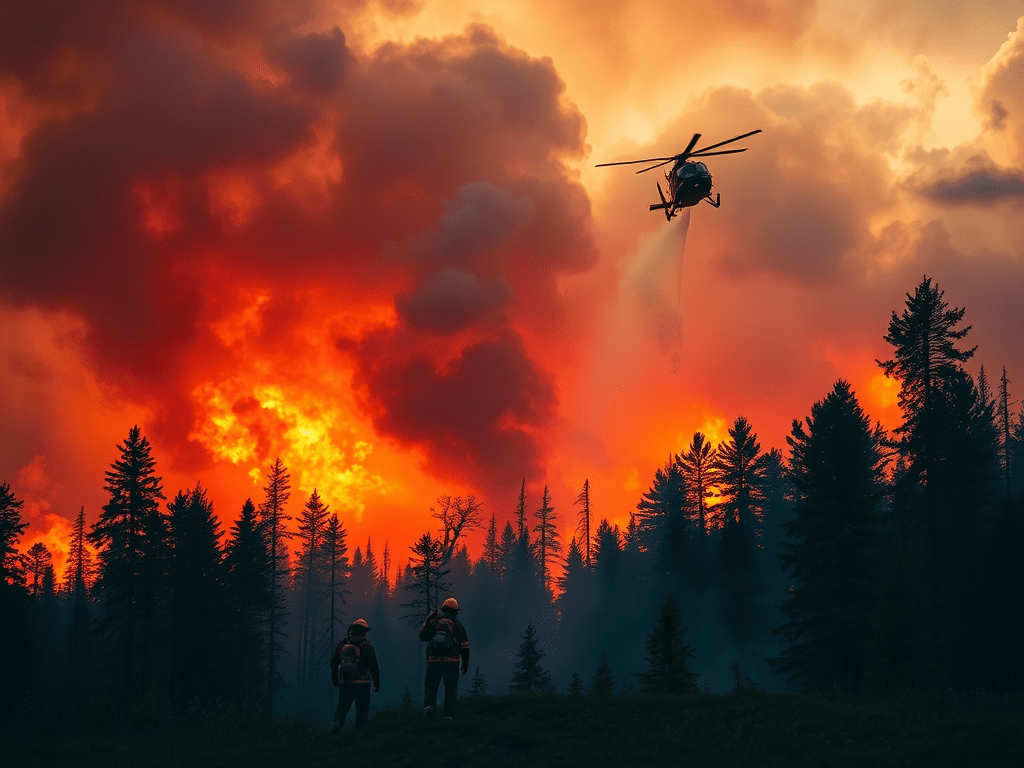
Needless to say, Canada is at it again with its forests on fire. Seems to be a routine annual occurrence now, doesn’t it? Like clockwork, only instead of the gentle chime of the hour, it’s the acrid smell of smoke, hazy skies, and the constant hum of helicopters trying to douse the flames with buckets of water that feel woefully inadequate. I’ve been reading up on the news more than I usually do—for someone who avoids the news like it might actually reach through the screen and infect me with negativity, that’s saying something (and it does because of how empathetic I am). And it looks like this year might just be chasing 2023 in terms of sheer fiery chaos. Ah, yes, 2023: “The Summer Canada Burned,” as some people decided to christen it. I don’t know who these people are, but they’re probably the same ones who make hashtags trend and see poetry in disaster. Kudos to them for the creativity, though I wish they didn’t have the material to work with.
So far, the air quality has been better, which is a weird thing to say when the index is sitting at the top of the chart. I mean, when your best comparison point is “well, at least the air won’t suffocate you this time,” it’s like grading on a curve in the most depressing way possible. The fact that I can tell it’s marginally better is terrifying in itself. Like, oh, my lungs adjusted to last year’s airborne ash cocktail, and now they’re ready for round two? Fantastic. We should hand out medals to Canadian lungs for endurance or maybe their sarcastic acceptance of the air we’re breathing. Or I should just take my inhalers cause I am asthmatic and you can really tell when I move about when the air is over a five, let alone ten.
This brings me to another thought entirely: resilience. Or maybe the illusion of it. What does resilience even mean when year after year, a country breathes smoke like it’s part of the atmosphere? When I think about resilience, I picture someone standing tall amidst adversity, unshakeable and somehow untouched. But the reality of resilience feels more like staggering forward, coughing through the haze, and pretending the air isn’t biting at your lungs like some invisible predator. It’s wishing for rain while knowing that, sometimes, even rain carries its own threats.
The fires ignite debates about climate change, forest management, and emergency preparedness, but what solutions are left when the problem already seems larger than our ability to address it? The news is relentless, the charts glaringly red, and all we’ve got are hopes pinned on rainfall and the heroism of exhausted firefighters. Every year, it feels like we’re watching a grim performance where the stage is forests lit aflame and the audience is choking on ash.
And yet, somewhere beneath the swirling clouds of smoke and the cracked earth of scorched landscapes, there’s a flicker of hope. Maybe it’s naive. Maybe it’s misguided. But it’s there, stubborn as ever, like the green shoots that push through burnt soil. We cling to the idea that next year will be different, less damaging, less suffocating. And in the meantime, the resilience grows—not perfect, not untouched, but enduring in its messy, imperfect way.
Speaking of things that should pack up and leave, thunderstorms. Not that I want to banish rain—no, heavens no, we need rain desperately. My province, like many others in Canada, is on fire yet again, and the ground is practically begging for some hydration. But here’s where I get selfish, and I’m not entirely sure I should feel guilty about it: I want the thunderstorms to leave. Lightning has that charming habit of setting things ablaze, and thunder? Oh, thunder, you noisy beast. Let’s face it, I have a complicated relationship with thunder. It’s the kind of relationship you’d file under “It’s complicated” on a social media profile while trying not to overshare.
And yet, amidst all this fiery chaos, the storms seem to arrive like uninvited guests to an already overcrowded party. They bring rain, sure, but also lightning—a notorious instigator, igniting dry forests like they’re kindling. It’s an ironic twist, isn’t it? The very thing we hope will quench the flames can sometimes worsen them. It’s a gamble we take, though, because the alternative—parched landscapes and unrelenting fire—is far worse. And while I wish rain could be a simple solution, nature seldom operates in absolutes. It’s a balance we haven’t quite managed to strike—a delicate, precarious dance between relief and destruction. Thunderstorms, with their booming declarations and electric drama, remind us that even the skies carry their own brand of unpredictability, an echo of the chaos on the ground.
Let’s not forget that fires can create their own weather system.
It’s almost mythical, isn’t it? The idea that fire—something born of destruction—could wield the power to create its own weather systems. But this isn’t mythology; it’s science, and it’s as awe-inspiring as it is terrifying. Wildfires, when raging at their peak, can conjure up their own pyrocumulus clouds, towering masses of smoke and heat that rise into the atmosphere like some apocalyptic monument. These clouds can generate winds, intensify the flames, and even produce lightning. Yes, lightning. Fire creating its own spark for more fire—a vicious, self-feeding cycle.
The phenomenon feels almost alive, like the wildfire is evolving, adapting to its surroundings, and refusing to be subdued. As the flames consume forests and fields, the heat rises, drawing air upward in powerful currents. The moisture released from burning vegetation mingles with the ascending smoke, and before long, a cloud forms. From the ground, it looks surreal—a dark, brooding mass with occasional flashes of light, as if the fire reached for the heavens and pulled the storm back down to Earth.
And yet, this fiery weather system is no ally. The winds it generates can scatter embers across miles, igniting new blazes in an instant. The lightning it produces strikes the dry land below, compounding the destruction. It’s nature’s cruel irony at its finest—a force that feeds itself, growing stronger with every breath it takes from the parched, scorched land.
It’s unsettling to think that something so destructive could also wield such creative power, even if that creation only brings more chaos. Fires, in their sheer intensity, become architects of their own environment, reshaping skies and landscapes alike. It’s a reminder of just how small we are in the face of nature’s forces—forces that don’t just consume but transform, leaving behind scars on the earth and stories in the sky.
So, the next time smoke-darkened skies loom overhead, remember that what you see isn’t just the aftermath of a fire—it’s the fire’s evolution into something larger, something unbridled. It’s not just burning; it’s building its own empire in the atmosphere, a fleeting yet formidable display of power that humbles us all.
Yea I keep avoiding the reason I started typing this post up. My fear of thunderstorms that is rooted in childhood trauma. Ground zero, quite literally, for me was when a tornado decided to make its grand entrance near where I lived. I don’t recall inviting it, but apparently, it thought it could just drop by. I was very young—too young, some people say, to have lasting trauma from it. Ah, the skeptics. “You were too young for PTSD,” they say, as though trauma politely checks IDs before deciding to embed itself in your psyche. Spoiler alert: trauma isn’t that considerate. That tornado marked the beginning of what I like to call my “Fear of Liquid in the Face Era.” It took me over two decades—yes, twenty-plus years—to reach the point where I could shower without needing what felt like a medieval strategy for defense. Imagine me with a stack of face cloths, determined to keep shampoo from invading my eyes as though it were a hostile army. And let’s not even talk about the neck pain from trying to wash long hair without letting water touch my face. Olympic-level neck contortion right there.
I’ve made progress, though. No longer do I fly into a full-blown fight-or-flight panic mode during showers. Small victories, right? These days, if I slip and get my face soaked, the panic is less dramatic—although I can’t promise I won’t fall trying to escape the shower, because, you know, coordination isn’t my strong suit when my brain decides to activate “Escape Mode.” If someone’s at home, they usually come to check on me if they hear the telltale signs of my scrambling. This isn’t exactly the stuff of glamorous anecdotes. “Oh, tell us a funny story about yourself!” someone might say. Do they really want to hear about how I once tried to flee the shower like it was haunted? Didn’t think so. Though it doesn’t take long for those I live with to tell me to not lock the door when I am showering just in case. Frankly, they are not wrong. Especially given my long term friendship with car accident injuries that won’t improve.
Face wipes, by the way, used to be my best friends. Not for makeup removal, mind you—just for basic hygiene, you know wash your face twice a day just like your teeth. But they were expensive, so I eventually got to say goodbye to them. My wallet has been very grateful ever since. These days, I’ve upgraded to washing my face with water. Big steps, right? I always keep a towel nearby, though. That towel is my security blanket, my safety net. If towels could talk, mine would probably have stories to rival memoirs.
But back to thunderstorms. Thunder is the real villain here, not rain. Rain I can handle; rain can even be soothing. Thunder, on the other hand, feels like an auditory punch to the gut. The louder it gets, the closer it comes, the more likely I am to curl up in a ball and disappear into a sensory overload vortex. That’s right: PTSD with a side of AuDHD, shaken, not stirred. When it gets really bad, I lose my ability to speak altogether. Today, the storm is still far away, but the thunder is so loud it feels like it’s knocking on my door, asking to come inside. The first boom was so intense I could feel it—a bone-rattling, window-vibrating kind of loud. And I am terrified of what it’ll be like when the storm arrives overhead.
Here’s a fun fact: I don’t scream anymore during thunderstorms. I used to scream, and not in a “let’s scream at the concert” kind of way, but in a “my soul is escaping my body through sound” kind of way. Now, I don’t scream, which is an improvement, I think? Is that progress? Or just a different coping mechanism? Either way, I’ll take it.
People often tell me I should grow out of this fear or “work through it.” They don’t understand. They think trauma has an expiration date, like milk or something. Sorry to disappoint, but trauma doesn’t follow those rules. It doesn’t spoil and then get thrown out. It lingers, evolves, and sometimes rears its ugly head when you least expect it. And let me tell you, there is no such thing as being “too young” for trauma. It doesn’t discriminate based on age. It doesn’t care if you’re five or fifty. If the circumstances are right—or wrong—it can latch onto you like an unwanted guest who overstays their welcome.
I’ve tried to live with it, though. I’ve managed to find humor in the chaos, which is maybe the best coping mechanism I’ve got. Humor is like a flashlight in the dark—sometimes it’s dim, sometimes it flickers, but it helps you see just enough to keep moving forward. So when I say I’m terrified of thunderstorms but also fascinated by lightning, I know it doesn’t make logical sense. But hey, who said trauma had to be logical? There’s something mesmerizing about lightning—its unpredictable bursts of energy, its jagged streaks across the sky. It’s like nature’s chaotic artistry, scribbling in the clouds. Watching it feels almost therapeutic, except for the nagging voice in my head reminding me that it starts fires.
And fires? Fires I am done with. Completely and utterly done. Canada has become a pyro’s dreamland, and I want no part of it. Every summer, it’s the same story: the forests rage, the smoke invades, and we all brace ourselves for the aftermath. I wish I could say I’m numb to it, but I’m not. I’m tired, annoyed, and just a little bit angry. Angry at the destruction, the loss, the helplessness. Angry at the fact that this is somehow becoming normal when a few things could be done to reduce the size these fires get to.
So here I am, dealing with thunderstorms, fires, smoke-filled air, and all the lovely baggage my brain carries. It’s chaotic, it’s messy, and sometimes it feels overwhelming. But you know what? Life is like that sometimes—chaotic, messy, and overwhelming. You keep going because, well, what else can you do? You find those small victories, those little moments of humor, and you hold onto them. You learn to live with your fears, your memories, your quirks. And for me, that means surviving thunderstorms, avoiding the news, and maybe, just maybe, hoping for a summer where Canada doesn’t burn.
 Who am I?
I would love to hear from you!