So, let me tell you something about being a night owl. It’s not just a quirky label or some kind of rebellious trait. It’s a whole lifestyle, a rhythm etched into the very fibers of certain bodies. And trust me, I know this because my body is one of those rogue agents that gleefully flips the bird at society’s diurnal dictatorship. As far back as I can remember, I’ve been at my most alive when the sun has gone to bed and the moon takes over. While most people are off dreaming of whatever it is that normal sleepers dream about—possibly spreadsheets, taxes, or golden retrievers—I’m wide awake, thriving in the stillness of the night.
My biology just doesn’t do mornings. I mean, mornings and I have a longstanding beef; it’s an ancient battle of groggy proportions. No matter how many alarms I set, how many hours of sleep I try to force myself into, or how many motivational posters I read about seizing the day, my body and brain conspire against me. You’d think I was trying to tame a feral cat instead of adhering to something as basic as a 9-to-5 schedule. And don’t even get me started on the grogginess during daylight hours. It’s like walking through molasses in a fog-filled swamp while someone occasionally whacks you with a rolled-up newspaper labeled “responsibilities.”
Now, let’s talk about why this happens, because apparently, I’m not just lazy or allergic to sunbeams (though, honestly, I might be). Science actually has my back on this one. Some of us are born with a chronotype—basically, your body’s internal clock—that skew toward nocturnal. It’s not that I want to be difficult; it’s that my melatonin, the sleepy hormone, doesn’t even think about activating until it’s embarrassingly late by societal standards. When most people are wrapping up their Netflix binges, my brain is like, “Ah, yes! Time to solve the universe’s mysteries and reorganize the spice rack by emotional significance.”
There’s a mountain of evidence that being a night owl isn’t just flipping off morning larks. Science has my back when I say that thriving in the moonlight doesn’t doom me to a caffeine overdose or eternal scorn from early birds. Apparently, my brain might be wired for creativity, problem-solving, and a unique productivity kick that only starts when the sun goes down.
Research from the University of Birmingham shows that us night owls tend to have higher cognitive ability scores than our early-rising frenemies. We ace a smorgasbord of tests on memory, attention, processing speed, and reasoning skills. In short, if you need someone to solve a Rubik’s Cube while composing a symphony at 2 AM, I’m your guy.
While early risers are busy being all efficient and productive during daylight hours (boring!), my nocturnal mind might be engaging in deep reflections, having life-changing conversations, or whipping up masterpieces in the wee hours. A study published in Sleep Medicine indicates that we night owls often kill it in tasks needing innovative thinking and dogged perseverance. Yeah, the research says we rock creative problem-solving and endurance testing, proving that burning the midnight oil can light up some serious brainpower.
Sure, there’s always the chance I’m doom-scrolling through my phone and chuckling at memes. But hold up! I can use these quiet hours for deep work, planning world domination, or learning to play the ukulele. My knack for focusing without daytime distractions makes me a prime candidate for careers like writing, programming, design, and any field where a bit of eccentricity is a bonus. So next time someone scoffs at my late-night habits, I’ll remind them that while they’re sleeping, I’m out here living my best, most chaotic, and creatively charged life.
Now, let me toss a wrench into this discussion—a little tidbit called understimulation, which I recently discovered, and which might just be the villain behind some of my woes. Understimulation is a particular hellscape where your brain feels like it’s running on an empty hamster wheel, craving input, engagement, something—anything—to light up the synapses. Turns out, for those of us with AuDHD (Autism and ADHD, for the uninitiated), being awake during the “normal” hours of the day might be extra challenging. Because, let’s face it, daytime can be painfully boring. There’s too much structure, too much expectation, and not nearly enough time for the kind of chaotic exploration that our brains crave.
It’s not just about staying awake when others are dreaming; it’s about experiencing a world that feels uniquely ours. The night offers a sanctuary, a fleeting escape from the chaos of daily life. Without the constant buzz of phone calls, meetings, and the unrelenting pace of daytime obligations, the night becomes a haven where thoughts can roam freely. These quiet hours let us dive into deep introspection, exploring ideas and emotions that often get drowned out by the clamor of daylight. It’s as if, in the embrace of darkness, creativity and clarity bloom in tandem, unburdened by the constraints of the clock.
When I learned about understimulation, a light bulb went off in my head—a dim, flickering light bulb because, again, daytime. Could this be why trying to live a daytime life was slowly eroding my will to function? Could this be what triggered my latest burnout? I mean, no matter how much I tried to play by the rules of the sunlit world, I always found myself sneaking back into the night within a day or two. It’s like my body and brain were staging a protest, complete with picket signs that read, “Let us vibe at midnight!” and “Sundown or meltdown!”
It’s fascinating how this nocturnal rhythm sometimes feels like a secret superpower, albeit one with limited acknowledgment. The quiet solitude of the night becomes a playground for imagination, a space untouched by the structured confines of the daytime world. For those like me, it’s a time when the distractions of the day fall away, leaving room for thoughts to expand without boundaries. While others succumb to the lull of sleep, my mind comes alive, mapping out stories, experimenting with new ideas, or diving into the depths of forgotten hobbies.
But let’s not sugarcoat it—this lifestyle isn’t without its challenges. Social obligations, work schedules, and the relentless march of a society geared for daylight make it a constant balancing act. For every burst of midnight energy, there’s the inevitable clash with a morning meeting or an early appointment that feels like cruel irony. I can’t count the number of times I’ve had to disguise my bleary-eyed exhaustion behind a mask of coffee-fueled determination, silently wishing the world would accommodate different rhythms for once.
During the day, my focus is a tragic comedy. I’ll sit there staring at a task, willing myself to care, and my brain just shrugs and says, “Nah.” Everything feels duller, slower, like an old computer trying to run modern software. But at night? Oh, at night, the fog lifts, my energy spikes, and suddenly I’m a human whirlwind of ideas and enthusiasm. Need to write a novel, bake a cake, and figure out how to start a podcast? Midnight Me is on it. Daytime Me, on the other hand, is lucky if it remembers to eat breakfast.
And let’s not forget the poetic charm of the night itself—the stillness, the dim glow of streetlights casting long shadows, and the way the world seems to hum at a lower frequency. In these hours, inspiration flows like an unbroken stream, free from the interruptions of the bustling daytime. The night feels like a blank canvas waiting to be filled, an endless expanse where thoughts stretch, twist, and evolve into ideas that wouldn’t dare surface under the glare of the sun. It’s as though the darkness carries its own kind of wisdom, urging you to think deeper, feel stronger, and create wildly.
Of course, this natural nocturnal tendency doesn’t exactly gel with the world we live in. Society is built for early risers. The 9-to-5 workday, the early morning school drop-offs, the “breakfast is the most important meal of the day” propaganda—it’s all stacked against us night owls. And while there are movements pushing for more flexible schedules and greater acknowledgment of different chronotypes, we’re still largely treated like the dysfunctional cousins of the productive morning people.
The battle between chronotypes and societal expectations may never reach a definitive truce, but what if we reimagined the field entirely? Instead of forcing ourselves into molds that only crack under pressure, we could start embracing the strengths that lie in our natural rhythms. For me, I think it is probably a combination of AuDHD and genetics that fuels my nocturnal tendencies. Night owls might not just survive in a daytime-dominated world; we might thrive in ways that defy conventional wisdom. Imagine a society that values productivity at all hours—a world where the midnight oil burns brightly alongside the morning coffee. Flexible work schedules, midnight art studios, and late-night brainstorming sessions could be the norm, not the exception. If we rewrote the rules of engagement, who knows what fresh innovations and collaborations might emerge from the shadows of the night?
Still, I can’t help but wonder—what if we leaned into these nocturnal vibes instead of trying to cram ourselves into a daytime mold that just doesn’t fit? What if the world wasn’t built around the assumption that productivity only blooms with the sunrise? Imagine a society where schedules ebbed and flowed with our natural chronotypes, where night owls and early birds could coexist without judgment or caffeine-fueled resentment.
Picture this: a world where late-night cafes buzz with thinkers, creators, and problem-solvers, their energy electric under the dim glow of streetlights. Offices with flexible hours hum with activity 24/7, accommodating brainstorms at midnight as easily as morning meetings. Schools adapt too, allowing students to learn at the times their brains are most alert, rather than forcing yawns and glazed-over eyes into desks before sunrise.
Such a shift might sound utopian, but it’s a concept backed by science. Studies reveal that mismatched schedules don’t just inconvenience night owls—they reduce overall productivity and well-being. By embracing a more fluid approach to time, we could unlock untapped potential and creativity in ways our rigid schedules currently stifle.
But let me tell you something—being a night owl isn’t a flaw. It’s not a problem to be fixed or a character defect to overcome. It’s just a different rhythm, one that doesn’t fit neatly into the constraints of the modern world. And maybe that’s okay. Maybe if we leaned into it instead of fighting against it, we’d unlock new ways of thinking, creating, and living. Maybe we’d even be happier, more fulfilled versions of ourselves.
Embracing our nocturnal nature isn’t about defying norms—it’s about recognizing and celebrating the way we’re wired. The world has long praised early risers as paragons of productivity, but maybe it’s time to rewrite that narrative. Night owls aren’t lazy or rebellious; we’re simply operating on a different rhythm. Our creativity sparks in the quiet hours when the world slows down, and that’s not a flaw—it’s a strength.
So, what if society stopped side-eyeing our late-night tendencies and instead leaned into them? What if we shifted from “Why aren’t you waking up earlier?” to “How can we make space for your unique energy?” By reframing productivity and success to include all chronotypes, we wouldn’t just empower individuals—we’d unlock untapped potential that’s been waiting for its moment to shine under the glow of the moon.
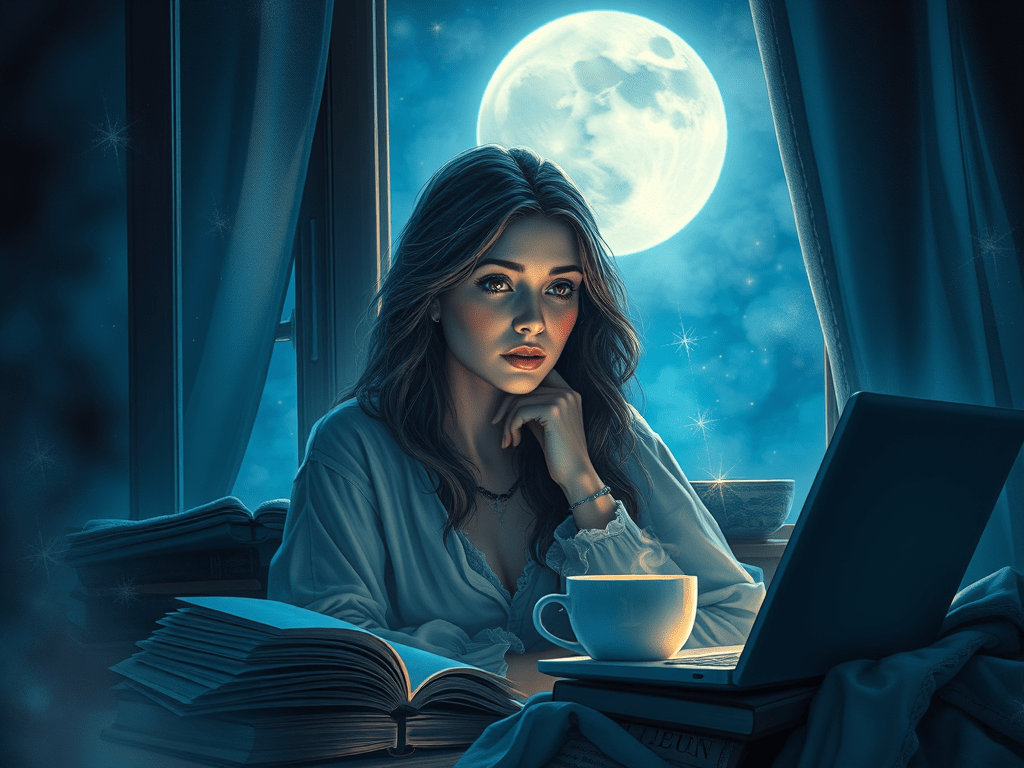
So, if you’re reading this at 2 a.m. like the kindred nocturnal spirit I suspect you are, know this—you’re not alone, and you’re not broken. The world might not be designed for us, but that doesn’t mean we can’t thrive in our own way. And who knows? Maybe one day, society will catch up to us night owls and recognize that the midnight hours hold just as much magic and potential as the crack of dawn—if not more. Until then, I’ll be here, basking in the glow of the moon, sipping my late-night tea, and wondering why the spice rack still doesn’t feel quite right.
And maybe that’s the point—embracing what feels natural, rather than reshaping ourselves to fit an ill-suited mold. There’s a quiet rebellion in being true to our rhythms, a kind of resistance that doesn’t shout but hums softly through the night. It’s in the scribbling of half-formed ideas at 3 a.m., the glow of a laptop screen illuminating a face deep in thought, or the contented sigh of finding clarity in the stillness while the rest of the world dreams.
Perhaps the magic lies not in seeking validation from a society rooted in sunlit hours but in creating our own spaces where the moonlight reigns supreme. Spaces where inspiration doesn’t punch a clock and where success isn’t measured by the early bird’s worm. For every sunrise worshipper, there’s a dreamer who sees the infinite possibilities of a star-studded sky, and maybe it’s time we made room for both.
Because here’s the truth: the world needs the dreamers and the doers, the planners and the ponderers, the morning optimists and the midnight thinkers. Together, we create a balance, a yin and yang of energy that fuels innovation and progress. After all, even the most radiant sun needs the velvet embrace of night to complete the cycle.
It’s a curious thing, isn’t it? That surge of clarity and energy that sneaks up on you just when the day seems determined to drag you under. You spend hours clawing your way through the haze, barely piecing together the puzzle of responsibilities, only for the fog to lift as the sun sets—suddenly, your mind sharpens, your ideas bloom, and sleep becomes an afterthought rather than a necessity. Why keep wrestling with a rhythm that refuses to be tamed? Why not embrace it instead, letting productivity find you in its own time rather than forcing it into spaces where it simply doesn’t belong?
Think about it: isn’t it better to pour yourself into the hours that feel alive, when your thoughts are crisp, and the world quiets enough to let your creativity flourish? Why chase exhaustion, losing the spark in the process, only to feel so out of sync that even your own thoughts stop making sense? There’s freedom in surrendering to your natural ebb and flow, in accepting that how you thrive doesn’t have to fit neatly into societal expectations. After all, life isn’t a one-size-fits-all equation, and sometimes the greatest clarity comes in the moments we’re told to close our eyes.
That said, I have been up all night. So, it is time for me to go and get my sleep. While the world is chaotic and I will see you when the night embraces this part of the world again. Or in a few hours if I can’t sleep even if it is my natural time to sleep. I just can’t win I tell ya, I can’t win.


 Who am I?
Leave a reply to ❄️Siearra Frost❄️ Cancel reply