
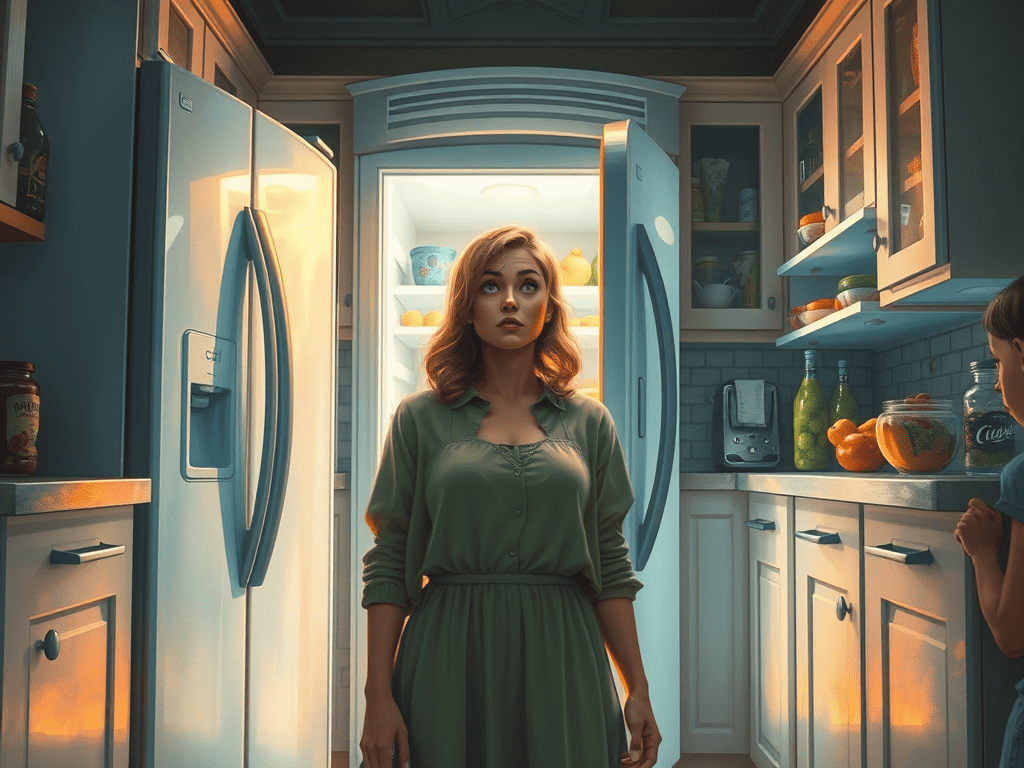
The other day, I stumbled into the kitchen with all the confidence of someone who absolutely knew what they were doing. Except—I didn’t. I mean, I knew I had a purpose, a mission, a quest, if you will. But the minute I crossed that invisible threshold between the living room and the kitchen, my brain suddenly decided to hit the “reset” button. I stood there for a good ten seconds, slack-jawed, staring at the fridge like it might whisper some ancient truth in my ear. Why was I here? Food? A drink? Was I planning to reenact a scene from a cooking show? Nothing. Just blank.
It turns out, this little phenomenon of walking into a room and immediately forgetting why you’re there actually has a name. It’s called the “doorway effect.” Sounds fancy, doesn’t it? Like some kind of scientific principle you’d hear about in a documentary narrated by David Attenborough. I can almost hear him now: “And here we observe the human, frozen mid-stride, perplexed by the mysteries of its own existence. What brought it here? We may never know.” Honestly, I’d pay good money for that.
But back to the doorway effect. Apparently, it’s not just me—and, I suspect, it’s not just you, either. It’s a universal quirk of the human brain. Scientists have studied this, which makes me feel slightly less ridiculous about my frequent moments of cognitive paralysis. There’s even research out there showing that something about physically crossing through a doorway triggers a kind of mental compartmentalization. Your brain is like, “Oh, new space! New context! Better file away whatever you were thinking about in the last room because THIS room is clearly more important now.” Spoiler alert: it’s not.
The great irony here is that the doorway effect is supposed to be a survival mechanism. You know, something that once helped our ancestors adapt to new environments, like moving from the open savanna into a forest. The brain needed to prioritize new information quickly, lest a sabertoothed tiger leap out from behind a bush. Fast-forward to modern times, and this same mechanism is now sabotaging me when I’m just trying to remember where I left my phone charger. Well and remember to eat cause you know AuDHD makes this its own little quirk and then this effect makes it worse! Evolution, you jack ass.
Now, let me set the scene for you: imagine walking into your bedroom with the clear intention of grabbing your car keys. You step through the door, and boom—mental amnesia hits you like a brick to the forehead. You’re suddenly looking around, vaguely inspecting your pillow and wondering if this is a metaphor for something deeper. Are the keys a symbol? Is this an existential crisis? No, it’s just your brain playing hide-and-seek with itself. And when you finally give up, trudge back to the living room where you started, and suddenly remember why you needed the keys in the first place, it feels like you’ve just completed some cruel cognitive obstacle course designed by a bored deity.
What’s worse is how this plays out in public. Ever walk into a store and immediately forget what you came to buy? There you are, awkwardly wandering the aisles, pretending like you’re browsing but clearly lost in a mental fog. People pass by, giving you polite nods, but you know that they know. They can see it in your eyes—the look of someone who’s forgotten the one item they came here for. Was it bread? Batteries? A new life plan? Who’s to say.
And let’s talk about the panic that sets in when you’re not alone in your forgetfulness. Say you’re with a friend, walking into a room together, and you both forget why you’re there. Now it’s a team sport. You exchange baffled looks, each hoping the other will magically remember the mission. “Why did we come in here?” “I don’t know, you were leading!” “Well, that was clearly a mistake.” At that point, you might as well just leave the room entirely and hope the memory resets itself, like a faulty Wi-Fi connection.
But here’s where it gets even weirder. Sometimes retracing your steps actually works, like walking backward through a glitch in the Matrix. Have you ever stepped back through the doorway, only to have the forgotten thought come rushing back into your brain as if it had been waiting for you on the other side? It’s like your memory is tethered to the room you left behind, refusing to follow you into uncharted territory. I find it both fascinating and deeply annoying. Like, is my brain running on 56k dial-up? Why does it need to buffer every time I walk five feet?
The doorway effect isn’t just limited to physical spaces, by the way. Oh no, this cerebral sneaky trickery happens in the digital realm too. Think about it: how many times have you opened a new browser tab, only to sit there staring at the blank search bar because you’ve completely forgotten what you were going to look up? And then you’re left frantically flipping through mental files, trying to remember that one thing you were absolutely certain was important enough to Google. It’s the digital equivalent of standing in the kitchen, staring at the fridge.
I’d like to believe there’s a way to outsmart the doorway effect, but every trick I’ve tried has backfired. Writing things down? Sure, except I usually lose the sticky note or forget where I put the list. Saying your intention out loud as you cross the threshold? Feels effective until your roommate overhears your muttering, “Get the scissors, get the scissors,” and suddenly questions your stability. The truth is that the doorway effect is just one of those delightful quirks of being human. Like hiccups or trying to fold a fitted sheet.
At the end of the day, I’ve come to accept that the doorway effect is less a bug and more a feature of my deeply flawed but occasionally charming brain. If nothing else, it gives me an endless source of self-entertainment and, let’s be honest, a perfect excuse to blame my forgetfulness on science. So, the next time you find yourself standing in a room, scratching your head and wondering why you’re there, just know that you’re in good company. And who knows? Maybe it’s not forgetfulness at all. Maybe you’re just giving the room a moment to appreciate your presence. Yeah, let’s go with that.
 Who am I?
I would love to hear from you!