
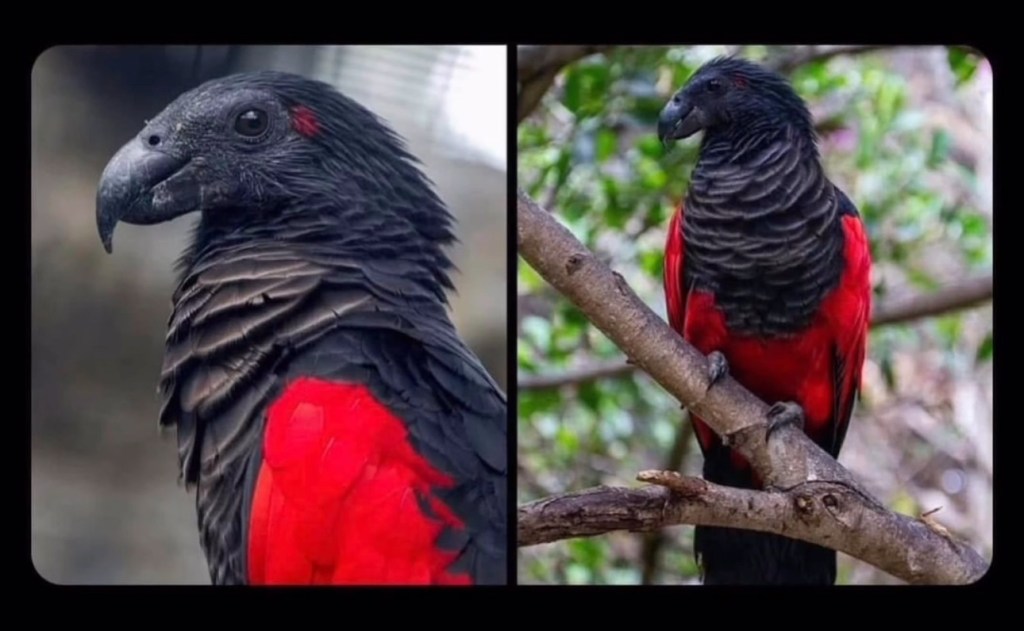
I must confess, the universe still manages to surprise me, even on the most ordinary of Thursdays. There I was, scrolling through my Instagram messages, when a friend dropped a phrase that stopped my caffeine-fueled brain in its tracks: “Dracula parrots.” I had forgotten because this bird for days I consider myself a reasonably knowledgeable individual, someone who knows that platypuses are real and that narwhals aren’t just the fever dream of an overzealous unicorn enthusiast. But Dracula parrots? Surely, this had to be a joke, or perhaps a new indie band, or maybe a misheard conversation about Count Dracula and his penchant for nocturnal birds. My curiosity, as always, was piqued.
Of course, the first thing I did was reach for the internet. You’d think at a certain age I’d be immune to rabbit holes, but no—especially not when vampiric birds are involved and of course AuDHD might contribute to this. I typed “Dracula parrot” into my search bar, expecting to be met with memes, perhaps a few photoshopped images of parrots with fangs, and the occasional reference to Bram Stoker’s infamous count. What I found, however, made me stare at my screen in slack-jawed amazement. The Dracula parrot is, in fact, very real—no capes, no Transylvanian castles, but every bit as dramatic as its gothic namesake.
Let me introduce you (as I was introduced) to the Pesquet’s parrot, sometimes called the “Dracula parrot” by those who, like me, have a flair for the dramatic on occasion. This remarkable bird hails from the remote mountainous rainforests of New Guinea, a place that already sounds like the setting for an adventure novel hmm maybe it will be. When I saw the first photograph, I was genuinely gobsmacked. Imagine a parrot, but instead of the standard-issue bright greens, blues, and yellows, this bird sports a sleek, jet-black body offset by a cloak of deep blood-red feathers. Its bald, vulture-like face gives it an air of mystery and perhaps a touch of menace. It’s not hard to see why someone, perhaps suffering from too many late-night horror movies and a love of all things macabre, decided to nickname it after the most famous vampire in literature.
But the resemblance to Dracula stops at the wardrobe and the slightly spooky vibe. As far as I could tell, no one has reported seeing a Pesquet’s parrot transform into a bat, sleep in a coffin, or harbour a suspicious aversion to garlic. Still, I can’t help but picture them swooping dramatically through the misty canopies of New Guinea, perhaps pausing to strike a pose for any passing naturalist armed with a camera and a vivid imagination.
Once I had established to my satisfaction that the Dracula parrot is a bona fide member of the animal kingdom, my next question was, naturally: what are their habits? Do they haunt the forest silently, like feathered phantoms? Do they gather in flocks aboard creaky wooden branches, exchanging spooky stories as night falls? As it turns out, these birds are as fascinating in behaviour as they are in appearance, though perhaps not quite as supernatural as I might have hoped.
For starters, Pesquet’s parrots have a preference for the high life—literally. They are most often found in the upper canopies of the tropical forests, flitting among the treetops like shadows with a hint of crimson. They’re not especially social birds, usually seen alone or in very small groups, which only adds to their air of mystery. If I were a parrot with such striking plumage, I’d want an entourage, but it seems the Dracula parrot is more the strong, silent type.
They’re not exactly loudmouths, either. While many parrots could give a punk rock band a run for their money, the Pesquet’s parrot has a relatively subdued call, described by those lucky enough to hear it as a series of raspy, croaky notes. It’s not quite the cackling of a villain in a black cloak, but it certainly adds to the bird’s unique charm. If you’re hoping to spot one in the wild, you’ll have a better chance listening for those low, grating sounds than any melodious birdsong.
Now, onto a crucial detail—what do Dracula parrots eat? After all, with that nickname, one might imagine a penchant for rare steaks or the occasional midnight snack of questionable origin. I must admit I was briefly concerned for the wellbeing of any small forest creatures within pecking range. Fortunately, the truth is far less chilling and much more befitting their parrot status. Pesquet’s parrots are, in fact, almost exclusively frugivorous and yes that is a real word apparently. Their diet consists mainly of a few species of figs, which they appear to consume with great enthusiasm. They don’t drain their victims of life force (or juice, for that matter); instead, they have a specially adapted beak that allows them to expertly extract the pulp from figs and certain other fruits found in their high-rise forest home.
It’s almost disappointing, in a way. Here is a bird with the dark looks and enigmatic aura of a literary villain, and yet it would rather tuck into a piece of fruit than anything remotely sinister. Perhaps there is a lesson here about not judging a book—or a parrot—by its cover. Still, I can’t help but imagine these birds as the gothic gourmands of the rainforest, delicately nibbling at their chosen fruits with all the poise of an aristocrat at a candlelit dinner.
One might wonder, with such a unique appearance and a surprisingly gentle lifestyle, how these birds fare in the wild. Sadly, as with many strikingly beautiful creatures, their feathers have made them a target. The Pesquet’s parrot is threatened by both habitat loss and hunting, particularly for its vivid plumage, which is used in ceremonial headdresses by certain local communities. Conservation efforts are ongoing, but their numbers remain in decline—a sobering reminder that even the most fantastical creatures need a little help from us mere mortals.
After all my research, I emerged from this particular rabbit hole (or should I say, parrot hole) with both admiration and a smidge of envy. The Dracula parrot, with its dramatic looks and quietly dignified manner, is the kind of creature that would make even the most seasoned birdwatcher’s heart skip a beat. So, if you ever find yourself wandering the misty rainforests of New Guinea and hear a croaky, raspy call overhead, look up—you might just spot one of the world’s most extraordinary parrots, contentedly snacking on figs and looking every inch the gothic superstar. And if you feel a chill in the air, don’t worry. It’s probably just the wind. Or perhaps, somewhere above, a Dracula parrot is watching with mild curiosity, wondering why humans get so excited about a little bit of red and black. I, for one, am delighted to know they exist—and even more delighted that they prefer figs to fangs.
 Who am I?
I would love to hear from you!