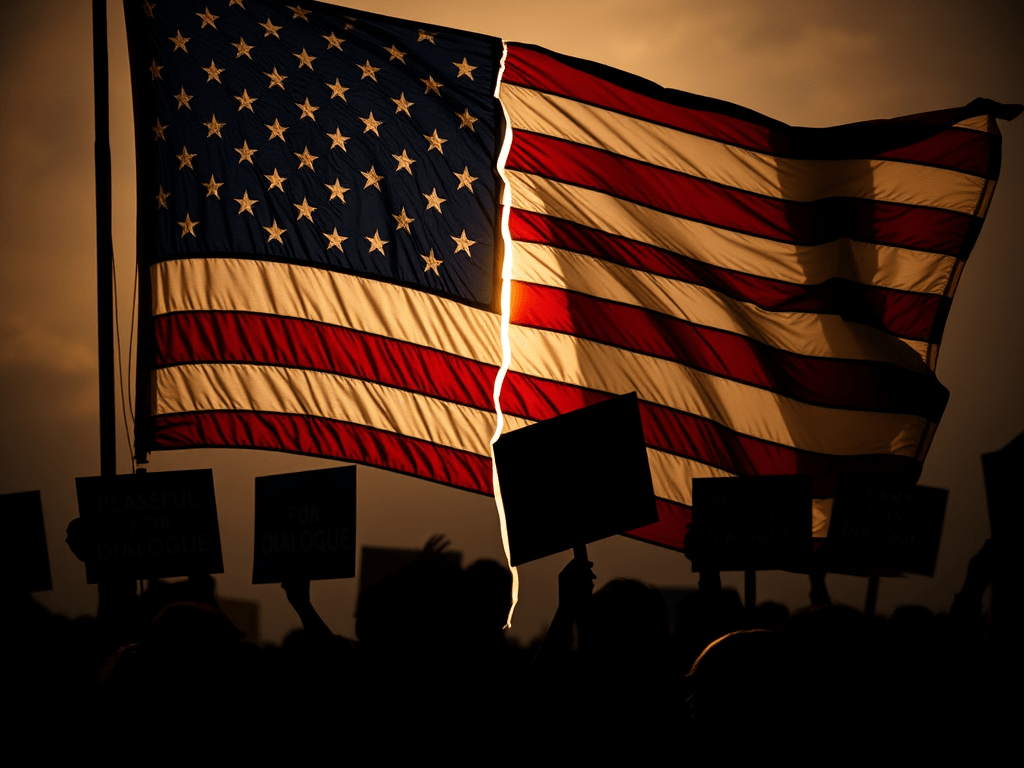
So I wrote this some time ago, when things had first started going sideways with the USA President that is currently in power. Today I have been reading over all of the news reports of the protests going on in Los Angeles in response to the immigration crack down. I can no longer hold back on this, as civil war in the USA not only affects them but every last country out there. I explain why below, I have spent the day working on verifying what I could from what I wrote and making sure it conveyed what I wanted. I have not added any new information or removed any information that I had found.
That said, even if no other country would be affected I am not one to be complicit. I have seen where that goes and the nightmares that are the result. All I need to do is look at the First Nations of both Canada and the United States and recall what happened last time the bystander affect occurred. It is not in me to remain quiet with such horrible things going on and with the way things are going it concerns me enough to speak up. I encourage others to do the same, now is not the time to sit back and watch and see what happens.
Now is the time to send a message to our own governments and push for them to assist in finding a peaceful solution to this situation we see just south of the boarder here in Canada, however I do not just speak to Canadians I speak to every single person who may read this. I encourage you to read what I have written, I encourage you to do your due diligence and I especially encourage you to speak up. I have, I sent a letter to my MLA today, which is another reason the post is so late in the day. I had to lead by example as that is who I am. I will not ask you to do something I will not do. This affects not just the States but the entire world, and frankly where it could lead scares the ever loving hell out of me which is why I hesitated on posting this. I did not want to send it out sooner then needed in case it was not needed, yet now there is no doubt in my mind.
We have seen what happens when situations like this are left unchecked. We have #215, WWI, WWII, the situation in Ukraine, this list goes on and I do not want to see yet another added to this nightmare list that should not exist in the first place. We borrow this world from our children and their children. It is our duty to ensure that it is here for them and in as peaceful of a condition as we can manage improving it each generation. We can not be complicit now, the results are far beyond what we can see if we are.
So I leave you with this writing that I had hoped with all I am to never need to make live, and it is with a heavy heart that I do so because the need is to great to delay any longer. Speak up, every single one of us has to. I beg you. On a side note tomorrow I will return to the usual content of chaos that is more fun and light hearted most of the time. We are the heart beat of change, lets show it.
Though this https://www.npr.org/2025/06/06/nx-s1-5422283/supreme-court-doge-social-security-records also is beyond wrong. Just another indication that I need to post this and not drag my feet anymore. I did include the link as I am still doing my own searching on this, yet as a medical provider I actually did puke at this one.
I woke up from a dream, not a nightmare, just a really intense one about what’s happening in the US and how bad things really are. I thought it would be a good idea to share what I find and my thoughts as I dive into this topic. It makes sense, given how I like to let my ideas flow freely.
So, what are the big signs throughout history that warn of a civil war?
Ø Political Polarization: When society gets deeply divided, often by ethnicity, religion, or ideology, it sets the stage for conflict. If political conversations become more hostile and uncompromising, it can mean trouble.
Ø Erosion of Trust in Institutions: When people stop trusting the government, courts, or police, it can destabilize a country. This often happens when there’s a lot of corruption, inefficiency, or authoritarianism.
Ø Economic Inequality and Hardship: When the gap between the rich and poor gets wider and there are economic crises like inflation, unemployment, or lack of resources, it can fuel anger and unrest.
Ø Weak or Fragmented State Authority: If a government can’t control parts of its territory or enforce laws, it creates power vacuums that insurgent groups can take advantage of.
Ø Rise of Armed Non-State Actors: The growth of militias, rebel groups, or other armed factions often signals a move toward organized conflict.
Ø Escalation of Protests and Violence: An increase in protests, strikes, or riots, especially if met with violent crackdowns, can heighten tensions and lead to broader conflict.
Ø External Interference: When foreign powers support different factions within a country, it can deepen divisions and make civil war more likely.
Ø Media and Propaganda: The use of media to spread hate speech, misinformation, or propaganda can worsen divisions and incite violence.
This is scary to see these factors being part of what we are seeing with the states. Being Canadian this concerns me due to the fact we share both our boarders with USA. How am I seeing each of these right now?
Ø Political polarization: The U.S. is deeply divided; Democrats and Republicans barely agree on anything, and it’s more about seeing the other side as the enemy. News and social media amplify this divide, creating echo chambers where people only hear what they already believe. Frustration, anger, and exhaustion with the system are everywhere. You see it in moments like the overturning of Roe v. Wade, which sparked celebrations on one side and protests on the other, or the Capitol riot after the 2020 election, fueled by claims of fraud. A recent Pew study even found that 65% of Americans feel exhausted by politics, and 55% feel angry. While this polarization alone doesn’t mean civil war, it’s a warning sign.
Ø Trust in American institutions—like the government, media, and public health agencies—has hit historic lows. Only about 20% of Americans trust the federal government to do what’s right most of the time. Moments like conflicting COVID-19 guidance or accusations of media bias have left people feeling let down. A recent example is the controversy surrounding the U.S. Supreme Court, where ethics concerns about justices accepting undisclosed gifts have fueled public skepticism. This erosion of trust weakens democracy and becomes a warning sign, especially if paired with polarization or economic struggles.
Ø Economic Inequality and Hardship in the U.S. are stark—the top 10% of earners control around 38% of national income, while the bottom 50% hold just 1.2% of total wealth. Rising costs for essentials like housing and healthcare have left many struggling to make ends meet. In recent months, food insecurity has surged, with millions relying on food banks due to inflation. Historically, similar economic divides have fueled unrest, making this another warning sign.
Ø Weak or Fragmented State Authority can be seen in moments where the government struggles to enforce laws or maintain control. The January 6 Capitol riot in 2021 exposed gaps in security and coordination, raising concerns about the ability to handle domestic threats. Since the overturning of Roe v. Wade, states have enacted vastly different abortion laws, creating confusion and uneven enforcement. Some states have even attempted to prosecute individuals traveling for abortions, highlighting cracks in coordination between state and federal authority.
Adding to this, ethics concerns about Supreme Court justices have raised public skepticism, with reports of undisclosed gifts such as luxury trips creating questions about impartiality and accountability. These examples show how weakened authority can destabilize governance
Ø Rise of Armed Non-State Actors is evident in the growing influence of extremist groups and militias. For example, right-wing extremist groups in the U.S. have been linked to acts of violence, including the January 6 Capitol riot in 2021, showcasing their ability to mobilize and challenge state authority. More recently, armed militias have been involved in border patrol activities, raising concerns about their role in law enforcement and the potential for escalation. These actors undermine state control and contribute to instability.
Ø Escalation of Protests and Violence is evident in the increasing intensity and frequency of demonstrations. For example, protests over police brutality have often turned violent, with clashes between demonstrators and law enforcement leading to injuries and property damage.
The Dakota Access Pipeline protests, which began in 2016, remain a significant example of environmental activism escalating into confrontations. These protests arose because the pipeline’s construction attempted to take shortcuts and extend beyond the land outlined in the agreement, threatening water supplies and sacred burial sites. The protests saw widespread participation from First Nations and Indigenous groups across Canada and the U.S., including the Standing Rock Sioux Tribe (leading the movement) Other Sioux tribes: Cheyenne River Sioux Tribe, Oglala Sioux Tribe, Yankton Sioux Tribe Lakota, Dakota, and Nakota Nations, Cree Nation, Blackfoot Confederacy, Crow Nation, Navajo Nation, Apache Tribes, Chippewa Cree, Ho-Chunk Nation, Menominee Tribe, Oneida Nation, Mohawk Nation, Anishinaabe Nation, Dakota, Nakota, Plains Cree, Woodland Cree (such as Bigstone Cree Nation, Driftpile Cree Nation, and Sturgeon Lake Cree Nation), Métis, Assiniboine, Blackfoot, Ojibwe, Northern Cheyenne, Arapaho, Crow, and Shoshone. Even smaller First Nations unified, even with others often with just one or two representatives, joined this peaceful resistance rooted in prayer. The first time you have ever seen so many of the Nations united, Despite the presence of women, children, and elders, law enforcement actions included the use of pepper spray, rubber bullets, and batons. Protesters were forcibly removed, some subjected to strip searches and mass arrests. Notably, no weapons were seen on the side of the First Nations, underscoring the peaceful nature of their protest. This incident not only underscores the unreasonable use of force by authorities but also highlights growing unrest, especially when combined with other risks like polarization or economic hardship. When you have the nations uniting from all across the continent you have a problem that needs attention now not yesterday.
More recently, tensions surrounding immigration policies have sparked confrontations at the U.S.-Mexico border, with protests escalating into physical altercations. These incidents highlight not just increasing unrest, but also the potential for disproportionate responses, as seen in the Dakota Access Pipeline protests and as you can see that caused a huge response. This is not what we want to see as every time this occurs the country further destabilizes.
Ø External interference is evident in the sustained efforts of foreign entities to influence U.S. political, social, and economic stability. In the aftermath of the 2020 racial justice protests, foreign actors were reported to have amplified misinformation and divisive narratives on social media platforms, exploiting societal tensions and deepening mistrust in institutions. More recently, during the lead-up to the 2024 U.S. presidential election, foreign actors were accused of using social media manipulation and cyberattacks to influence voter sentiment and heighten political polarization. Today, foreign actors continue to exploit societal divisions by spreading misinformation about key issues such as immigration and climate policies. Additionally, ongoing cyberattacks targeting critical infrastructure, like energy grids and financial systems, pose a significant threat to stability and public trust. These actions by external actors undermine national unity and contribute to ongoing instability.
Ø Media and propaganda have played a significant role in shaping unrest in the U.S., both historically and today. During the aftermath of the 9/11 attacks, media coverage and government messaging amplified fear and suspicion, leading to widespread support for policies like the Patriot Act, which raised concerns about civil liberties and surveillance. More recently, during the 2024 presidential election, social media platforms were flooded with misinformation campaigns, polarizing voters and deepening divisions. Today, media coverage of the nationwide “Hands Off” protests against President Trump and Elon Musk has sparked debates about bias and the role of media in shaping public opinion. These protests, which address issues like budget cuts and threats to democracy, highlight how media narratives can influence perceptions and mobilize dissent. Media and propaganda continue to influence public perception and contribute to societal instability.
As we see when breaking down how these points are currently affecting the U.S., it becomes disturbingly clear how dire the situation is. The U.S. is alarmingly close to the tipping point where the convergence of these destabilizing factors could lead to civil conflict. In fact, I believe we are far closer to this critical moment than we realize. Globally, there may be a tendency to view the U.S. as resilient due to its democratic traditions and economic power. However, history shows that even strong nations can succumb to internal conflict when these factors compound. However looking at each point that is where we see globally just prior to civil war, this paints a terrifying picture to say the least.
The interplay of factors like polarization, distrust, economic struggles, weak state authority, and rising unrest is creating a fragile environment that mirrors those seen in the lead-up to civil wars throughout history. The erosion of trust in institutions has left many feeling disillusioned, while deep political divides are fueling hostility and frustration. Economic inequality continues to widen, leaving marginalized communities further behind and deepening resentment. Militia groups and armed non-state actors are becoming more prominent, challenging the authority of the government and creating the conditions for escalation.
Based on historical patterns, the U.S. appears dangerously close to the point of no return. Civil wars often erupt when societal divisions, distrust in institutions, and economic hardship reach a critical mass, leaving little room for reconciliation or effective intervention. While it’s impossible to pinpoint an exact threshold, history shows that once these destabilizing factors converge and reinforce one another, the tipping point can arrive suddenly and unpredictably. Events like the Capitol riot and escalating protests demonstrate how quickly isolated incidents can escalate into broader unrest. The presence of armed groups, external interference, and manipulative media further amplifies divisions, accelerating the erosion of national unity.
The U.S. is at a critical juncture, where immediate action is needed to address these issues and restore stability. Without intervention, the risk of crossing the point of no return grows exponentially. History has shown that once a society reaches this stage, reversing course becomes increasingly difficult, as the divisions become entrenched and the possibility of reconciliation diminishes. It’s unsettling to recognize how closely these patterns align with those seen in past civil wars, and the window for intervention is rapidly closing. The fragile state of unity and stability demands immediate and effective action to prevent escalation. The urgency to act cannot be overstated, as the window for preventing escalation is rapidly closing. This is not just a domestic concern—it has global implications, as instability in the U.S. could ripple across international systems.
Here’s the updated version, incorporating the gravity of the situation and historical examples of complicity:
Do Not Stand By
I’ve been reflecting on this lately, and it took me a few days to decide on posting—not just because of its length, but for other reasons too. The truth is, even as a writer, addressing this feels monumental, almost paralyzing. Putting it into words carries weight, a weight that impacts everything—my thoughts, my beliefs, even how I see the world. This gnawing feeling that we are watching history edge closer to repeating its darkest chapters has consumed me. And yet, what do I see around me? Silence, filling the void where action should rise.
This isn’t someone else’s problem; it’s ours. It’s mine. It’s yours. We are dangerously close to a tipping point, and the warning signs are unmistakable. The U.S. teeters on the brink of instability, and the ripples from that extend far beyond its borders. None of us will remain untouched.
This is a disaster waiting to happen—one that could be worse than any natural disaster we’ve seen, possibly worse than the world wars we’ve already endured. It is still preventable, yet every day we wait makes it that much harder to stop. We’ve seen what complicity has done in the past. We saw it with Hitler’s rise to power, where silence allowed atrocities to unfold. We saw it with Residential schools, where generations of Indigenous children suffered while society turned a blind eye. We saw it with the Rwandan genocide, where international inaction cost nearly a million lives. We saw it with the Kitty Genovese case, where bystanders failed to act as a woman cried for help. Let us not make this mistake yet again.
Do not stand by silently—dig deep, seek the truth, and refuse to accept misinformation or complacency. Raise your voice to your government representatives and demand accountability and action. Let them know that watching from the sidelines is not an option when unity and stability are at stake.
This applies to everyone, not just those in the U.S. International pressure from other governments is critical to deterring conflict and promoting accountability. Advocate for your own leaders to take a stand. Let it be known that inaction in the face of a preventable disaster is unacceptable.
Something as simple as sharing a post that highlights how serious the situation is, or writing one yourself, puts pressure where it’s needed. It may feel small, but small actions build into powerful waves of change. Silence is complicity—change begins when we refuse to ignore the warning signs and demand better, together.
 Who am I?
I would love to hear from you!